Take Home Points
- Timely planting of soybean is critical to achieve high soybean yields. In many instances this means as early as field conditions allow but generally at or after Risk Management Agency (RMA) replant crop insurance dates begin.
- Timely planting allows for soybean to maximize light interception, achieve higher crop growth rate, increased node number, and lengthen the seed filling period.
- Careful planning and timely crop management decisions can minimize downside-risks of early planting.
Introduction
Soybean planting dates can vary greatly depending on soybean growing region. Timely soybean planting is just as critical for attaining high soybean yields as it is for other crops such as corn and wheat. Generally, soybean responds better to early planting but the degree of soybean yield response is dependent on field productivity, variety characteristics (i.e. pest tolerance or resistant traits), maturity group, growing season, pest control (i.e., weeds, insects, and diseases) and weather conditions. Early soybean planting requires additional management to minimize risks and gain intended benefits. Such management often includes variety selection, seed treatments, seed vigor testing, and careful planning in the off season.
When To Plant Soybean
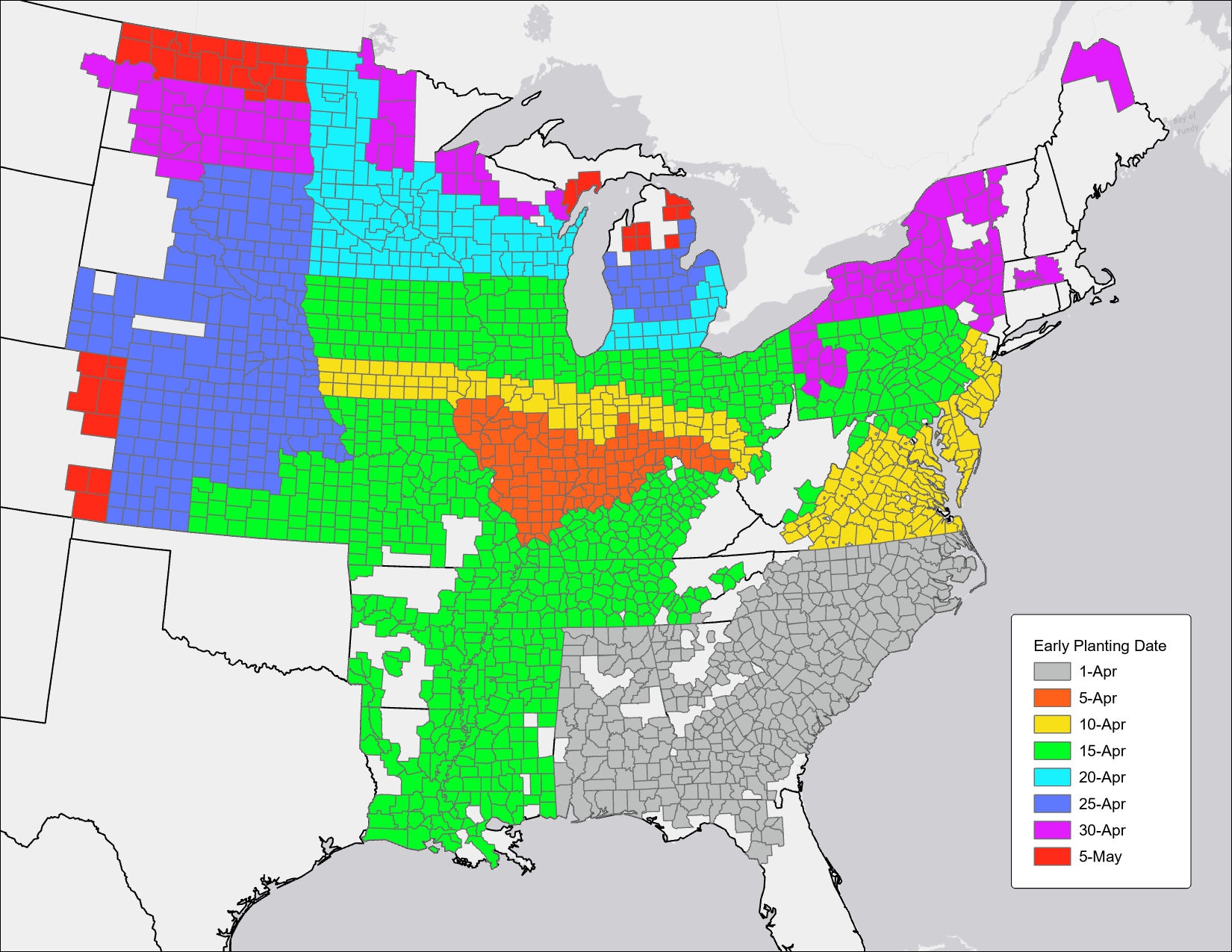
Deciding when to plant soybean should be based on field suitability and soil temperatures at the time of, and following, planting, as well as frost forecast. Rapid soybean germination and emergence occurs when soil temperature is greater than 75° F. However, waiting for 75° F soil temperatures may sacrifice maximum yield potential. Soybean can germinate and emerge when soil temperatures are at or just below 50° F; emergence at soil temperatures between 50 and 60° F typically takes about 15 to 20 days following planting. Planting at soil temperatures below 50° F could result in greater risk of seed and seedling pathogen infection and, thus, lower plant stands. Planting into a wet seedbed or following too much tillage can result in compaction and soil crusting which could reduce stand establishment. At the same time, planting into extremely dry soil can also be detrimental to stand establishment due to insufficient soil moisture for germination and/or emergence. We do not recommend widespread ultra early planting (i.e., February in southern regions; March in northern regions) and suggest that farmers align with RMA crop insurance planting dates (Image 1).
Benefits to Early Planting
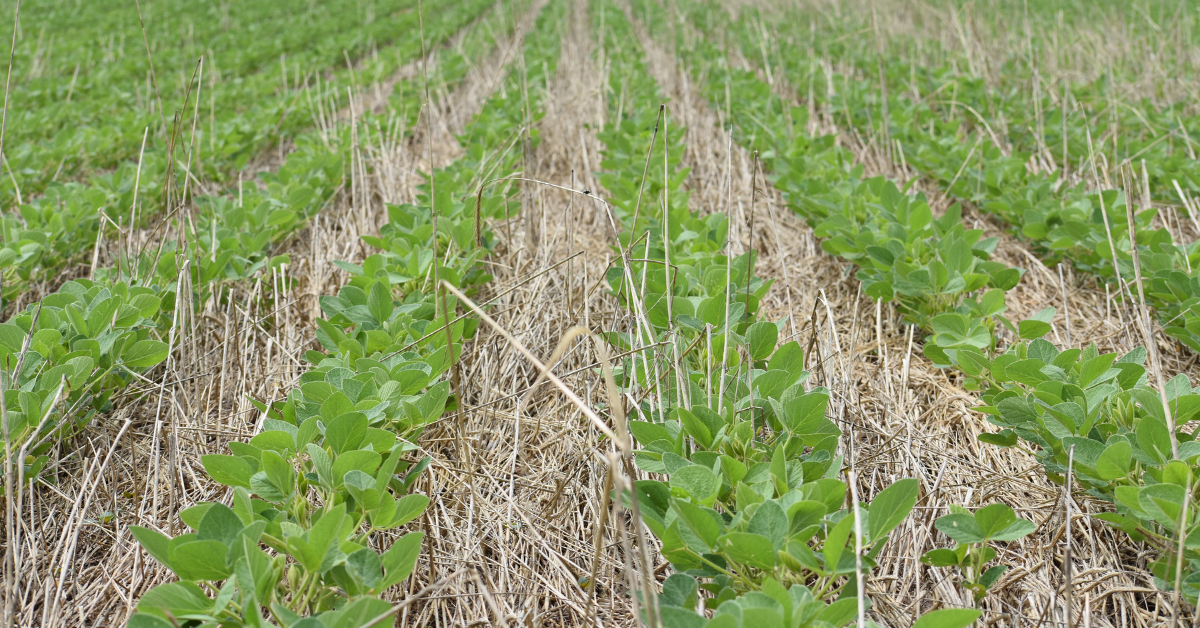
The number one benefit to early planting of soybean is higher yield! The magnitude of the yield response is region and environment specific but can be up to 0.5 bu per acre per day. This ‘free’ yield increase is one important reason that soybean planting dates should be planned, rather than simply follow once other field crops are planted. In general, the yield benefit is likely due to several physiological changes in today’s modern soybean varieties. First, accelerated yield gain has been measured in today’s modern genetics when planted early. The mechanism for this response is not fully understood but is likely related to canopy development and biomass accumulation. On average, soybean plants add one main stem node every 3.7 days after the first trifoliolate appears until seed development begins. Each stem node is associated with flowers, then pods, and then seeds. Because of this, an earlier start to the growing season results in more main stem nodes for flower, pod and seed production. Delaying planting by seven days can result in the loss of two main stem nodes. Greater biomass production is also advantageous for weed management. The quicker the soybean canopy is closed, the more competitive the soybean is with weeds, especially those weeds with an extended emergence pattern such as waterhemp and Palmer amaranth.
Second, modern soybean varieties flower up to 1 week earlier and are in the reproductive growth stages for up to 14 more days than older varieties. Delayed planting results in a shorter period for vegetative growth and ultimately a shortened growing season which reduces nutrient and photosynthate accumulation needed for pod and seed formation. Recent data from Iowa indicates that a 30 day delay in planting date can reduce the duration of seed fill by 5 to 10 days. These physiological changes can be optimized when planting early and growing conditions are good during the seed fill period.
The yield benefit to an earlier planting date is extremely variable across the soybean production areas of the United States (Image 2). This yield response is often non-linear; a simple “bushel per acre per day” number can be misleading. The penalty for delayed planting is often low over the first few weeks of May then increases as planting is further delayed. This varies by region; soybean yield loss from May 1 to May 31 ranges from 2.2% in Georgia to 42% in an irrigated system in Nebraska. Knowing the benefits of early planting in a specific region allows the grower to accurately assess the need to push earlier planting dates and offset potential risks with the reward of higher yield potential.

Early-planted soybean typically benefit from better soil moisture availability at planting and during early stages of vegetative growth. In some areas of the US, early-planted fields may be able to avoid drought stress during seed fill due to earlier maturity. However, low soil temperature and heavy rainfall can inhibit plant growth following early planting, which can lead to severe yield reductions. Although choosing the optimal planting date can reduce water stress on soybean during seed fill, in dry environments irrigation is often required during the soybean growing season. Water stress, which often coincides with high temperatures, is a leading cause of yield loss. When water availability, or what it costs rule out the use of irrigation, producers rely solely on rainfall to meet the water demand of the crop. Soybean planted during the middle of the planting window or late (including in a double-crop system) is more likely to require pre-bloom irrigation than early planted soybean.
Risks to Earlier Planting
Early planted soybean are at increased risk for early season frost or freeze damage in many areas of the US. It is important to understand the duration and temperature at which this injury can occur. Tissue freezing does not occur at 32° F or above because the stem, hypocotyl, and cotyledons contain high sugar solutes that act as “antifreeze”. Thus, air temperatures surrounding the tissue need to get to below 32° F for several hours before tissue freezing can occur. Secondly, the soil surface is typically warmer than the air temperature, particularly when the soil is wet. In actuality, the interface between soil surface temperature and air temperature near the soil surface will be closer to the soil temperature than to the air temperature. Also, cotyledons are a huge mass of tissue at about 95% water. This water-filled tissue is slow to freeze unless the exposure is several hours in duration. Soybean are most susceptible to frost injury during the crook stage and when the cotyledons are no longer closed and thereby protecting the apical meristem and unifoliates. If the apical meristem and unifoliates are killed then branching will occur at the two axillary meristems found at the cotyledons. Yield is not affected when regrowth occurs to soybean damaged at this stage.
An effective stand is important to maximize soybean seed yield. However the downside yield risk of poor stand establishment is minimal until stands fall below 50,000 – 75,000 plants per acre, depending on region and time planting and stand reductions. Early planting coupled with genetic improvement in the ability of soybean branches to contribute yield at low populations have effectively reduced the yield penalty for thin stands by 50%. Therefore we recommend the following:
- Early planted soybean yield is maximized with final stands between 100,000 (high yield environment) to 135,000 (low yield environment) plants per acre.
- When early season stands are less than the 50,000 to 75,000 plants per acre threshold, inter-plant into the existing stand with a similar maturity. Do NOT tear up the stand and start over.
- When stands fall between optimal and 50,000 plants per acre, Think Twice Before Replanting Soybean. Data shows a potential for a nominal ~2 bu/ac yield increase in this situation. But remember that replanting is almost always late planting. Even with “free replant” seed, costs labor, fuel and equipment wear and tear may be greater than the value of added yield from replanting. In areas of the field with more than 50,000 healthy plants per acre, investing in an effective in-season residual herbicide to control weeds such as Palmer amaranth and waterhemp may pay off better than replanting.
Soybean planted early in the spring into soils with temperatures below 60° are at an increased risk for seedling diseases (caused by Fusarium spp., Pythium spp., Phytophthora spp., Rhizoctonia solani) and sudden death syndrome (SDS; caused by Fusarium virguliforme), which will become apparent later in the growing season. To reduce the impacts of these diseases in early-planted soybean, varieties with resistance and appropriate fungicide seed treatments are recommended. This is particularly important for fields with a history of Phytophthora or SDS. At one time, delayed planting was recommended as a management strategy for reducing the impact of SDS. This is no longer the case. Choosing a tolerant variety and utilizing an effective seed treatment is the most effective strategy in managing SDS to maximize soybean yield potential for fields with a history of SDS.
Early-planted soybean may also be at an increased risk for insect damage. In southern regions, bean leaf beetle (BLB) can cause considerable physical damage and may transmit viruses. Insecticide seed treatments can reduce BLB damage but have not been proven to always impact yield. In areas of extreme BLB pressure, it may also be necessary to scout fields for BLB populations beginning approximately two weeks after soybean seedling emergence and to consider foliar insecticide applications if thresholds are met. Slugs can also be a damaging pest of early-planted soybean, especially in high residue situations. Insecticide seed treatments have also contributed to greater slug damage. The most economical control for slugs is dry, sunny days. In the south, kudzu bug has also been documented to have stronger pressure in earlier planted soybeans.
Another concern for early-planted soybean is the seed vigor/accelerated aging of the soybean seed lot. Seed vigor is a measure of the ability of seeds to produce normal seedlings in stressful conditions. This differs from seed germination, which is how many seeds can produce normal seedlings under ideal conditions. There are very few ideal soybean fields, which makes seed vigor a very important consideration for early-planted and extremely late-planted soybean. In most years, seed germination and seed vigor are quite high and there is little need for concern. However, there are years that seed vigor can be extremely low. Therefore, to reduce the risk of a failed planting, it is important to consider testing all your seed lots intended for early or very late planting dates for vigor.
Authors: Shawn Conley, University of Wisconsin; David Holshouser, Virginia Tech University; Matthew Inman, Iowa State University; Chad Lee, University of Kentucky; Laura Lindsey, Ohio State University; Mark Licht, Iowa State University; Hans Kandel, North Dakota State University; Jonathan Kleinjan, South Dakota State University; Carrie Knott, University of Kentucky; Seth Naeve, University of Minnesota; Emerson Nafziger, University of Arkansas; Jeremy Ross, University of Arkansas; Maninderpal Singh, Michigan State University; Jim Specht, University of Nebraska; Rachel Vann, North Carolina State University.