
Read the story: Biological Seed Treatments – The Big Picture
Despite the amount of biostimulant seed treatment products marketed to soybean growers, there is a severe lack of unbiased, field-based research on whether these products improve soybean yield and profitability.
To evaluate the effect of different biostimulant seed treatment products on soybean yield, nutrient status, and seed quality (protein and oil content).
Growers need data to determine if biostimulant seed treatments are beneficial for improving soybean yields and seed quality in order to make informed decisions about their use.
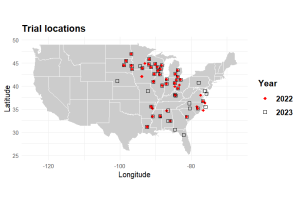
Rotation 1 will occur from 2024-2025, rotation 2 will occur from 2025-2026.
Laura Lindsey, The Ohio State University
lindsey.233@osu.edu
We thank all the supporting field staff at each university for their help in conducting and collecting data at their respective sites. This research was co-funded by the United States Department of Agriculture NIFA AFRI and the United Soybean Board. Additional funding support was received from the Qualified State Soybean Boards in participating states.
This project aims to quantify the amount of nitrogen (N) soybean crops provide to subsequent corn, as current recommendations are inconsistent across regions. It aims to create reliable data to help farmers and support sustainable farming practices.
The overall goal of this project is to quantify nitrogen credits from soybean to subsequent corn.
These results are needed because it has the potential to save soybean farmers money by reducing nitrogen fertilizer costs for the next crop, potentially saving $13.60 per acre. It aims to update nitrogen credit recommendations based on modern soybean varieties, management practices, and weather conditions. These results are important to show because it informs the sustainability of the soybean value chain.
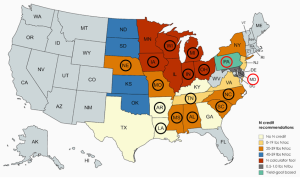
Rotation 1 will occur from 2024-2025, rotation 2 will occur from 2025-2026.
Mike Mulvaney, Mississippi State University
mjm1166@msstate.edu
We thank all the supporting field staff at each university for their help in conducting and collecting data at their respective sites. This research was funded by the Multi-regional Soybean Check-off
Potassium (K) deficiency is one of the most important yield limiting factors in soybean production with challenges in both diagnosis and corrective applications.
Researchers at the University of Arkansas have recently confirmed widespread “hidden hunger,” (in-season K deficiency) as well as provided improved diagnostic and corrective abilities in furrow irrigated soybean. This allows for accurate diagnosis of hidden hunger.
To validate improved tools and methods for diagnosing and addressing K deficiencies, including tissue testing, a dynamic critical K curve, and the 4-R’s of in-season K applications across different soils, environments, and irrigation systems
Four Rs of Nutrient Management:
Farmers nationwide need reliable strategies to detect and correct K deficiencies to improve soybean yields and enhance production efficiency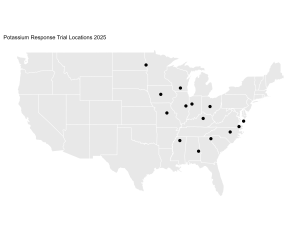
Field research will begin in 2025, intended to provide expanded recommendations in the following years. Best nutrient management always begins with soil testing and following your state fertilizer recommendations. The best way to manage a K deficiency in soybean is to avoid it with proper pre-plant applications following the 4 R’s of nutrient management.
Carrie Ortel, Virginia Tech University
carrieo@vt.edu
We would like to thank all the participating university staff for their collaborative efforts to collect this data. Additionally, sincere appreciation is extended to all cooperating Qualified State Soybean Boards for their funding and support.
Read the Story: Exploring Desiccant Usage for Better On-Farm Decision Making
Soybean producers face challenges at harvest, including extreme rainfall, uneven soybean maturity, and early frost, which can complicate timely and efficient harvesting. Pre-harvest desiccants (harvest aids) offer the potential for earlier, more uniform soybean harvest; however, soybean producers are concerned about reduced soybean seed yield and quality when making the decision to apply a desiccant.
To evaluate the impact of planting date, maturity group (MG), and desiccant timing on soybean seed yield and quality.
Producers need data on how pre-harvest desiccants affect seed yield and quality to make informed decisions about their use for earlier and more uniform soybean harvests.
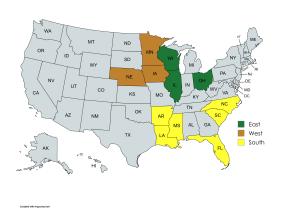
Experiment began in 2024 and will continue through 2025.
Mark Kendall & Shawn Conley, University of Wisconsin – Madison
mark.kendall@wisc.edu | spconley@wisc.edu
We thank all the faculty and field staff at each university for their help in conducting trials at their respective sites and collecting data. We would also like to thank AgStat Statistical Consulting for data analysis and the University of Minnesota Extension Soybean Program for soybean protein and oil analysis. This research was funded by the United Soybean Board.
Global soybean demand relies on seed quality, which is heavily influenced by farmers’ management decisions—especially harvest timing. As extreme weather makes delayed harvests more common, their impact on seed quality remains poorly understood.
As extreme weather events become more frequent, delayed harvests are increasingly unavoidable. However, little research has explored how these delays affect the quality and composition of soybean seeds. Most existing studies focus on storage conditions or aging, leaving a gap in understanding the direct impact of harvest timing across different environments and growing seasons.
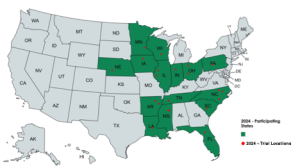
Experiment began in 2024 and will continue through 2025.
This results of this study will inform how harvest timing affects soybean seed quality and composition. It will also examine how management choices, weather, and environmental conditions interact to influence seed quality and profitability. The goal is to identify the best farming practices to protect seed quality and improve results for farmers at local, regional, and national levels.
Laura Lindsey, The Ohio State University
lindsey.233@osu.edu
This research was funded by the United Soybean Board. Thanks are extended to all the supporting field staff at each university for their help in conducting and collecting data at their respective sites.
There is a need for more research on how soil health tests can help US soybean farmers make better decisions, especially regarding the effectiveness of conservation management practices.
To identify soil health tests that are linked to soybean yield by analyzing long-term trials and evaluating how different management practices affect soil health and yield.
The results will help farmers understand which soil health parameters influence soybean yield and identify management practices that improve both soil health and yield.

Shawn Conley, University of Wisconsin – Madison
spconley@wisc.edu
This research was funded by a USDA-NIFA-AFRI grant and the Wisconsin Soybean Marketing Board. Thank you to all academic staff and students involved in the execution of the field projects sampled as part of this collaborative study.
Soybeans rely on biological nitrogen fixation (BNF) for 40-60% of their nitrogen, but gaps in our understanding of the process limit farmers’ ability to improve soil health and nitrogen use efficiency.
To study the soybean rhizosphere (root) microbiome across different U.S. locations and determine if seed inoculants affect how these microbes develop and function.
Better understanding of BNF and the soybean microbiome will help farmers improve nitrogen management and provide information on the efficiency of biological seed treatments.
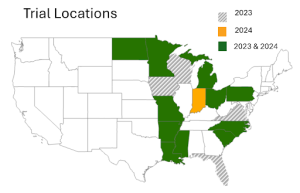
Manni Singh, Michigan State University
msingh@msu.edu
We extend our gratitude to the dedicated field staff at each participating state for their invaluable assistance in conducting the study and collecting samples and data. This research was made possible through co-funding from the Michigan Soybean Committee and Project GREEN (Generating Research and Extension to meet Economic and Environmental Needs), with participating states also receiving funding from the Qualified State Soybean Boards.
Seth Naeve, naeve002@umn.edu
