Since terms may vary throughout the U.S., these definitions may clarify terms used in this paper.
- Plant stand/Population | Number of plants emerged per acre.
- Repair-plant/Fill-in/Overseed | Replanting portions of the field.
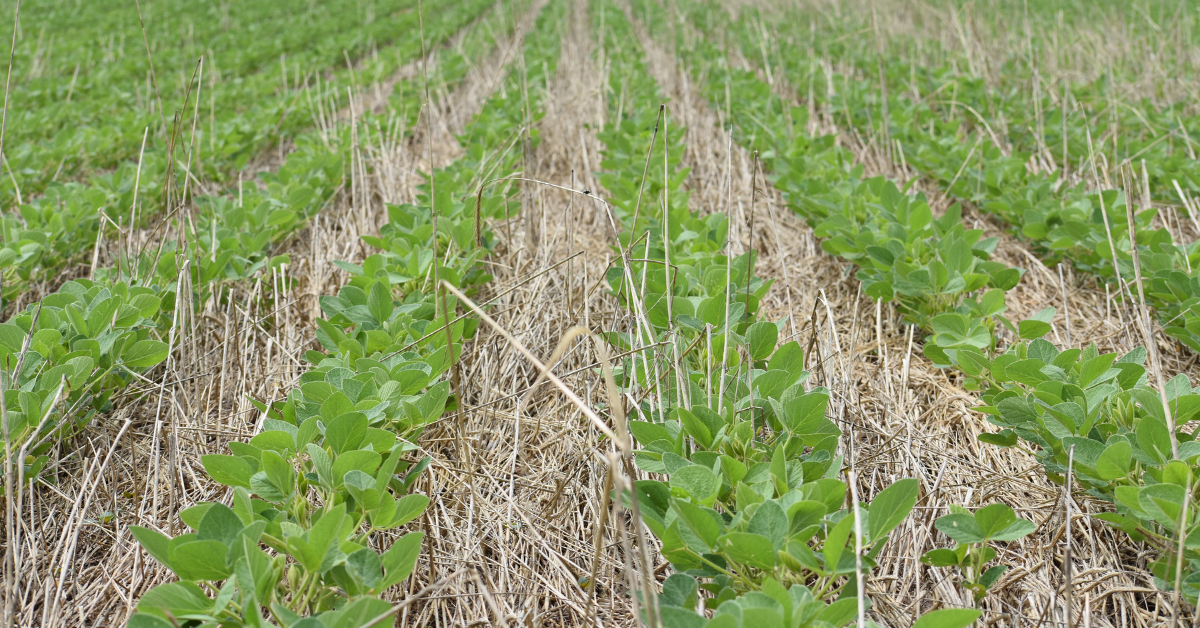
Early in the growing season, abiotic (freezing temperatures, hail, flooding, etc.) and biotic (slugs, deer, disease, insects, etc.) factors often reduce soybean plant stands. A soybean field with poor seedling vigor, slow plant growth, and low plant stand often triggers an “I need to fix this” impulse. However, these fields don’t always need to be replanted. This fact sheet addresses some commonly asked questions to consider prior to replanting a soybean field.
Take Home Messages
- If possible, repair-plant to improve the final stand instead of completely starting over.
- The minimum soybean stand required to produce 95% of a full yield has been found in research to be as low as 50,000 plants per acre, but more than that may be safer in the case of adverse growing conditions (Gaspar and Conley, 2015).
- The decision to repair-plant should focus on profitability, not on an emotional response to beat-up stands and seedlings.
At what plant stand do we need to consider action?
Soybean plants have a remarkable ability to compensate for open spaces by developing axillary branches that set additional pods. These axillary branches allow the plant to close open spaces and yield two or three times as much as plants that are crowded from normal planting populations (Suhre et al. 2014). With low final stand counts, it is common to have gaps larger than a square foot. Soybean plants will not be able to completely fill in these gaps which will result in yield reduction.
Action 1: Even minor stand loss warrants going across fields to assess the amount and pattern of plant loss.
Action 2: Stand loss that leaves fewer than 50,000 to 60,000 evenly- distributed plants per acre in southern regions, or 75,000 plants per acre in the most northern growing regions, or stand loss patterns that leave areas of more that 6 to 10 square feet in size without any plants, should be considered for replant.
How do I decide whether or not to replant?
Factors for evaluating whether to replant are:
- The existing plant stand, distribution of the plants, and their ability to recover full growth;
- Calendar date (effect of delayed planting and relative maturity);
- Weed management situation;
- Seed and variety availability;
- Cost to replant and insurance availability;
- Trade off: suboptimal stand vs. yield penalty to delayed replanting.
Stand Count
The minimum soybean stand required to produce 95% of a full yield has been found in research to be as low as 50,000 plants per acre. Most research has shown the need for higher populations, in part because factors such as an initial late planting date or cool or dry weather do not always allow lower stands to form complete canopies (Gaspar and Conley, 2015). This differs across regions, but in most situations, it likely takes 70,000 to 75,000 healthy and uniformly distributed plants to reach 95% of the yield produced by full stands. In warmer regions and with later-maturing varieties that develop more vegetative growth, this threshold can be lowered by 10,000 to 15,000 plants.
Calendar Date
Replanting means delayed planting, so the yield benefit of improving stands needs to be balanced against the yield effect of delayed planting.
Do I fill in ("repair-plant") or start over?
Although we use the term “replanting,” there are few instances when destroying the existing plants (“starting over”) in a damaged stand is beneficial. In practice, we almost always plant additional seed into existing stands. The planting process destroys some existing plants, but most of them remain alive and contribute to yield. “Repair-planted” soybeans may mature a little later, which may delay harvest but has no other negative effect.
Though we recognize the potential loss in yield when soybean stands are lower, replanting guidelines are difficult to develop and to put into practice. In many cases, emerged stands are so poor that the decision to replant is an easy one. The fact that the yield losses with planting delays are more gradual in soybean than in corn also makes it easier to decide to replant soybeans that have poor stands. For example, if the final stand was less than half of the initial planting population, many farmers would replant a field without much question if this could be done by the end of May in northern soybean regions or even early June for more southern locations. In these situations, the yield reduction from the later replanting date may be less than from the poor final stand. One advantage to planting soybeans later than corn, and into warmer soil, is that stand problems appear quicker in soybeans and can be dealt with more timely. Still, replanting costs time and money, and it should be done only if the need is clear.
The answer to when an original stand should be replanted is often obvious — for example, when heavy rainfall or standing water reduces stands to zero in parts of fields or to very low levels in entire fields. Where there are no plants left in places (such as low-lying areas) but the rest of the field has adequate stands, only the damaged areas may need to be replanted. Where stands vary across the field from low to high, then “repair-planting” can be done in the more damaged areas. Wide planters now in common use make it necessary to plant wide strips in order to fix small problem areas, so some “repair” plantings end up adding seed in most or all of a field.
What yield loss will this injury lead to?

In order to evaluate if a plant has the ability to recover from injury, it is important to know if the plant has undamaged growing points or axillary buds (Figure 1). The terminal growing point at the top of the plant is a group of rapidly dividing cells where new leaves are forming. The leaf axil is the point where the leaf’s petiole (its stem) is attached to the main stem or a branch. Axillary buds are located inside the leaf axils and are also growing points, but are semi-dormant as long as the growing point at the top of the plant is alive. When the top of the main stem is cut off, any one of these axillary buds may grow and ultimately replace what was the main stem. On normally growing plants, branches may grow from these axillary buds when soybean stands are sparse. Flowers and pods may also form from these buds.
The vegetative stages begin when the seedling emerges and end at flowering, which begins the reproductive stages. During the vegetative stages, leaves develop and grow, the root system develops, the main stem and branches grow, and reproductive structures begin to form. Vegetative stages normally develop to the V4-V6 stage before flowering and the reproductive stages begin. For a detailed description see https://bit.ly/soybeangrowthstages.
A soybean plant will usually regrow when the main stem has been cut off above the cotyledonary node. The cut-off may have been due to damage from insects, rabbits, deer, hail, sand blasting, or other causes. One or more axillary buds may develop after a main stem has been cut. Usually one becomes dominant because it develops to a greater degree than other “branches.” Later, it can easily be mistaken for the original main stem unless the lower plant section is carefully inspected to locate the cut-off point. Plants cut off below the cotyledons will not recover. In any plant stand evaluation, count these plants as dead. While some hail damaged plants that look like they should recover do eventually die, most regrow from either one or both of the axillary buds located at the node below where they were cut off. Plants cut above the cotyledonary node will regrow if there is sufficient cotyledon tissue to provide the plant with energy to regrow. Plants cut off above the unifoliate node can regrow from any of the four axillary buds located in axils at the cotyledonary node, and the unifoliate leaf node.

Loss of a cotyledon
The cotyledon leaves provide the plant with energy for the initial growth. When one of the cotyledons is removed, the plant still has enough energy in the remaining cotyledon to continue growth and development. When both cotyledons are damaged, the plant can slowly recover via the axillary buds in the leaf axil; however, growth will be delayed.

Early loss of the apical meristem?
When the dominant growing point is damaged or cutoff, one or more axillary buds lower on the stem will develop into new growth and the plant will resume development.
Broken plants
If a plant is broken, the axillary buds, if present, below the breaking point will be activated and regrowth will occur from these buds. If the breaking point is below the cotyledon leaves, the plant will die as there are no axillary buds below the breaking point.
What is the cost of doing nothing?
Often, the recommendation from Extension is for a farmer to wait seven to 10 days after an event to determine if a replant is needed or do nothing to maximize the field level economic return. It is important that we address the challenge with this advice. The first is that it is human nature to immediately fix a problem as inactivity is difficult. In the context of this topic, the wait-andsee approach to “fixing” a stand has implications for delayed planting and yield loss due to that delayed replanting. A final significant challenge is a reputational one – the perception, or “cafe talk” that a farmer with damaged fields “isn’t on top of things.” Competition for land and land rent contracts adds weight to such perceptions.
If suboptimum plant stands are kept, farmers might make some adjustments to help maintain yields. Especially on row widths 30 inches or wider, complete canopy closure may be delayed or never reached. Open canopies can bring more weed pressure due to less shading of the soil, and additional herbicide applications may be required. Fields with irrigation might have lower irrigation efficiency due to increased evaporation. In the mid-south, it has been observed that soybean fields without complete canopy closure have higher populations of corn earworms than fields with full canopies. Such fields may need more intense scouting to identify pest problems, and additional pesticide applications may be required.
What is the cost of doing something when I should have done nothing?
This is lost time and revenue that can only be measured by leaving strips untouched. Many would prefer not to know, but leaving strips would help gain knowledge for the next time. Regardless, it’s important to be prudent when fixing stand problems, and not to spend extra time and money needlessly.
What type of injury will a soybean plant recover from?
What is the yield impact of hail/leaf loss at the vegetative stages?
Hail injury can include loss of leaf area, bruising of stems, and, in severe cases, cutting off of plants. Bruises usually occur on the lower portion of the stem. The intensity of bruising ranges from a mild bruise, which is a simple break in the outer stem tissue, to a severe bruise, which exposes the central stem tissue. Bruises may be entry points for bacteria or fungi. Bruised stems typically remain functional, but they may be brittle, and subject to breakage at any time before harvest. Such broken-over (lodged) plants usually produce pods and seeds, but they may be difficult or impossible to harvest off the ground. Yield is not affected on bruised plants that do not break over. The challenge is to accurately determine which plants will break over at a later time, and which plants sustained only slight bruising. Regardless of crop injury level, there are no data that support applications of fungicides or biostimulants to improve recovery of soybeans from hail damage.
Chemical drift including dicamba
Low amounts of chemical drifting onto plants at early growth stages can cause visual damage to the new leaves. With enough moisture available, such plants will usually recover. Damage from larger amounts of chemical from sources such as tank contamination or misapplication may badly damage or even kill plants. In such cases, it may be necessary to assess whether or not the chemical in the soil will affect newly-planted seed or seedlings.

Deer, rabbit, or bird damage
Animals may remove the top growth of the plant or even eat the plant and leave only a stem below the cotyledon. Birds, in rare cases, may dig up soybean seeds, or feed on the leaves. If axillary buds remain on the plant, regrowth will occur, but growth and development may lag behind those of intact seedlings.
Flooding
Saturated soils after planting may kill seeds before emergence or kill seedlings after emergence. Flooding later during the season, lasting a few days with high temperatures, can also kill plants. Plants may be able to survive short periods of flooding, especially if the weather is cool. Such plants may be stunted, and can suffer from diseases such as phytophthora that spread in standing water. Crop injury from water logging is difficult to assess. Water-logging can reduce soybean yield to 52% at the vegetative growth stage (Oosterhuis et al., 1990). Yield losses are the result of reduced root growth, shoot growth, nodulation, nitrogen fixation, photosynthesis, biomass accumulation, stomatal conductance, and plant death due to diseases and physiological stress (Oosterhuis et al., 1990; VanToai et al., 1994 and 2003).

Slugs
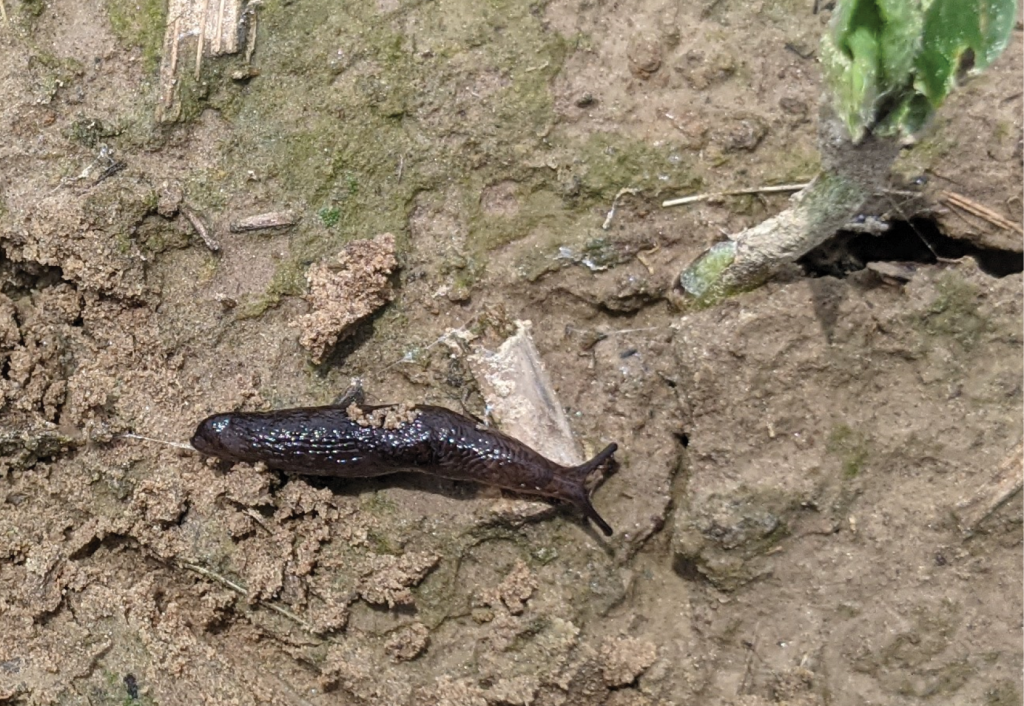
Slugs may be problematic in fields with a high level of plant residue on the soil surface (e.g., notill fields), especially in environments such as cool temperatures, high soil moisture, and cloud cover that result in slow plant growth. Slugs can feed on soybean cotyledons and the growing point, which can kill plants.
Crusting
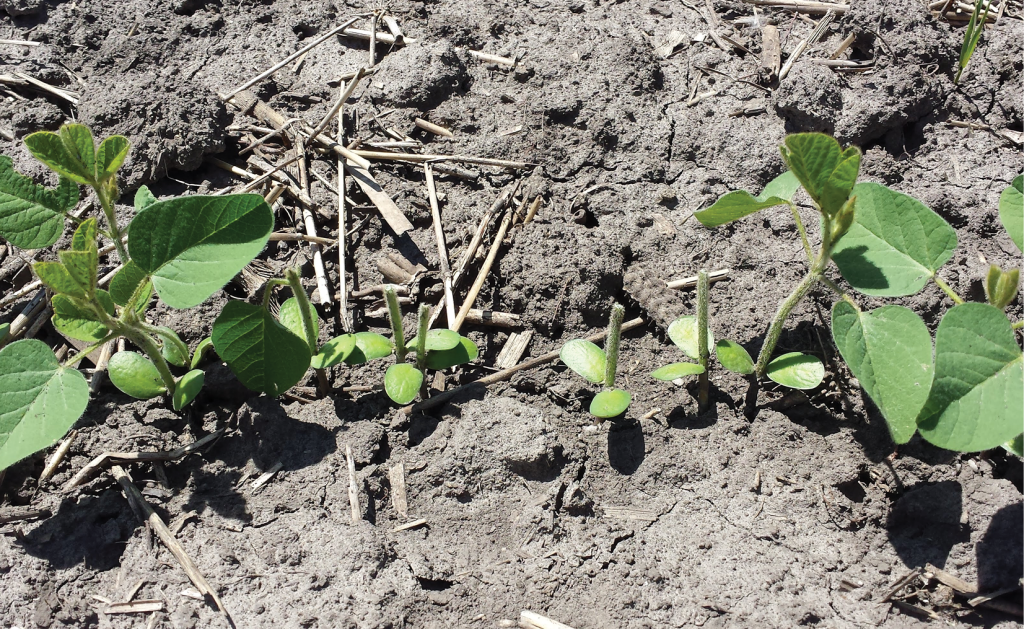
Heavy rains after planting followed by rapid drying (warm, windy weather with a lot of sunshine) can result in soil crusting, especially in some tilled, heavier-textured soils with lower organic matter. Under such a crust, germinating seedlings often lack the energy needed to pull their cotyledons through the soil to emerge. If the crust persists, seedlings will eventually die. The result can be an uneven and lower plant stand.

Frost
Temperatures below 32 F early during the season will cause water in soybean plant cells to freeze and resultant ice crystals will kill cells by damaging the cell membrane systems. How the crop reacts to freezing temperatures depends on where the growing points are.

Environmental conditions before or immediately after a low temperature influence the extent of freezing injury. If the temperature drop is gradual, plants are in better condition to resist injury due to low temperatures. Similarly, slowly rising temperatures after a frost and adequate soil moisture conditions are desirable to aid recovery. However, drought conditions, wind, and high temperatures are likely to aggravate frost injury and lessen the chance of recovery.
Soybean plants may leaf out again after a light frost from axillary buds. However, if tissue is damaged from the top to below the cotyledons the plant will die.
In evaluating frosted seedling fields, consider the percentage of plants killed and the percent recovered. The surviving plants should be evenly distributed in a field. Even if many of the seedlings in a reasonable stand are frost killed, the field will usually produce higher yields when left rather than if re-seeded. The remaining plants may require five to eight days longer to mature; but a re-seeded crop will require an even longer period to reach maturity.
Authors: Jenny Carleo, North Carolina State University; Daniela Carrijo, Pennsylvania State University; Shaun Casteel, Purdue University; Shawn P. Conley, University of Wisconsin Madison; Eros Francisco, Auburn University; David Holshouser, Virginia Tech University; Hans Kandel, North Dakota State University; Jonathan Kleinjan, South Dakota State University; Chad Lee, Mark Licht, Iowa State University; Laura Lindsey, The Ohio State University; Emma Grace Matcham, University of Florida; David Moseley, Louisiana State University; Mike Mulvaney, Mississippi State University; Seth Naeve, University of Minnesota; Emerson Nafziger, University of Illinois; Michael Plumblee, Clemson University; Giovani Preza Fontes, University of Illinois; Jeremy Ross, University of Arkansas; Maninder “Manni” Singh, Michigan State University; Rachel Vann, North Carolina State University.
References:
Gaspar, A. P., & Conley, S. P. (2015). Responses of canopy reflectance, light interception, and soybean seed yield to replanting suboptimal stands. Crop Science, 55(1), 377-385. https://doi.org/10.2135/cropsci2014.03.0200
Oosterhuis, D.M., Scott, H.D., Hampton, R.E., & Wullschleger, S.D. (1990). Physiological response of two soybean [Glycine max, (L.) Merr.] cultivars to short term flooding. Environmental and Experimental Botany, 30(1), 85-92. https://doi.org/10.1016/0098-8472(90)90012-S
Suhre, J. J., Weidenbenner, N. H., Rowntree, S. C., Wilson, E. W., Naeve, S. L., Conley, S. P., Casteel, S. N., Diers, B. W., Esker, P. D., Specht, J. E., & Davis, V. M. (2014). Soybean yield partitioning changes revealed by genetic gain and seeding rate interactions. Agronomy Journal, 106(5), 1631-1642. https://doi.org/10.2134/agronj14.0003
VanToai, T.T., J.E. Beuerlien, A.F. Schmithenner, and S.K. St. Martin. Genetic variability for flooding tolerance in soybeans. Crop Science, 34(4), 1112-1115. https://doi.org/10.2135/cropsci1994.0011183X003400040051x
VanToai, T. T., Roberts, G., Yang, Y., Ling, P., Boru, G., Hua, D., Bishop, B., & Kacira, M. (2003). Monitoring soybean tolerance to flooding stress by image processing technique. In T. VanToai, D. Major, M. McDonald, J. Schepers, & L. Tarpley (Eds.), Digital Imaging and Spectral Techniques: Applications to Precision Agriculture and Crop Physiology (pp. 43-51). The American Society of Agronomy. https://doi.org/10.2134/asaspecpub66.c4