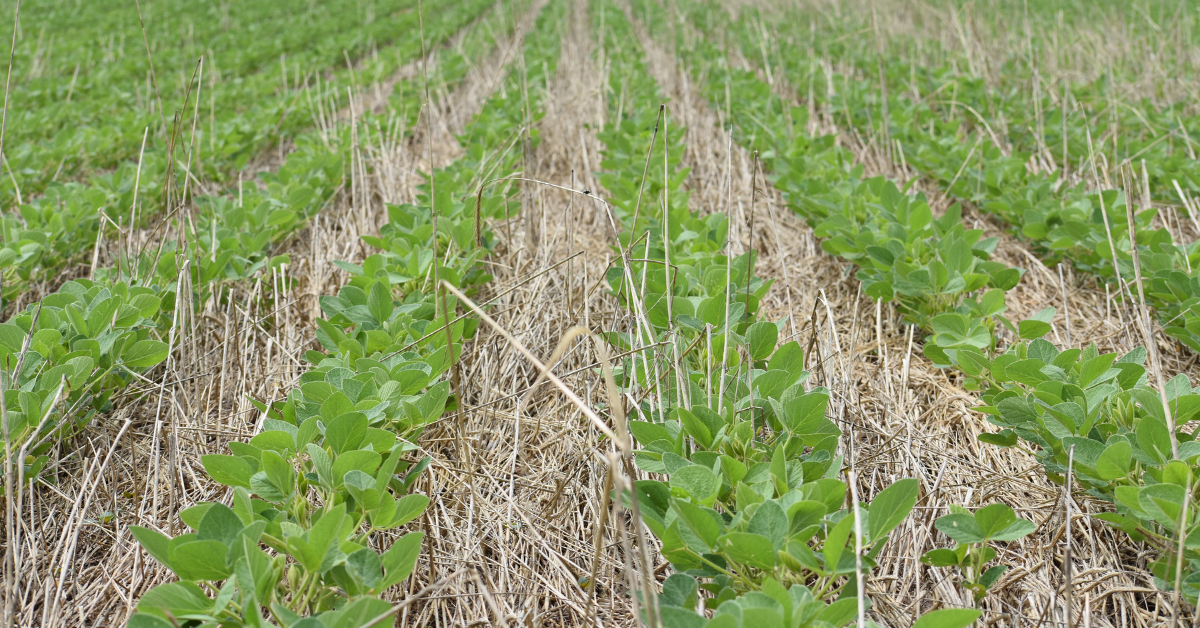
Understanding soybean water use is essential for effective irrigation management. By pairing this knowledge with a well-planned irrigation schedule or tool, farmers can optimize both water use efficiency and profitability.
Key Takeaways
- Soybean water use is not static across the growing season; it changes with plant development.
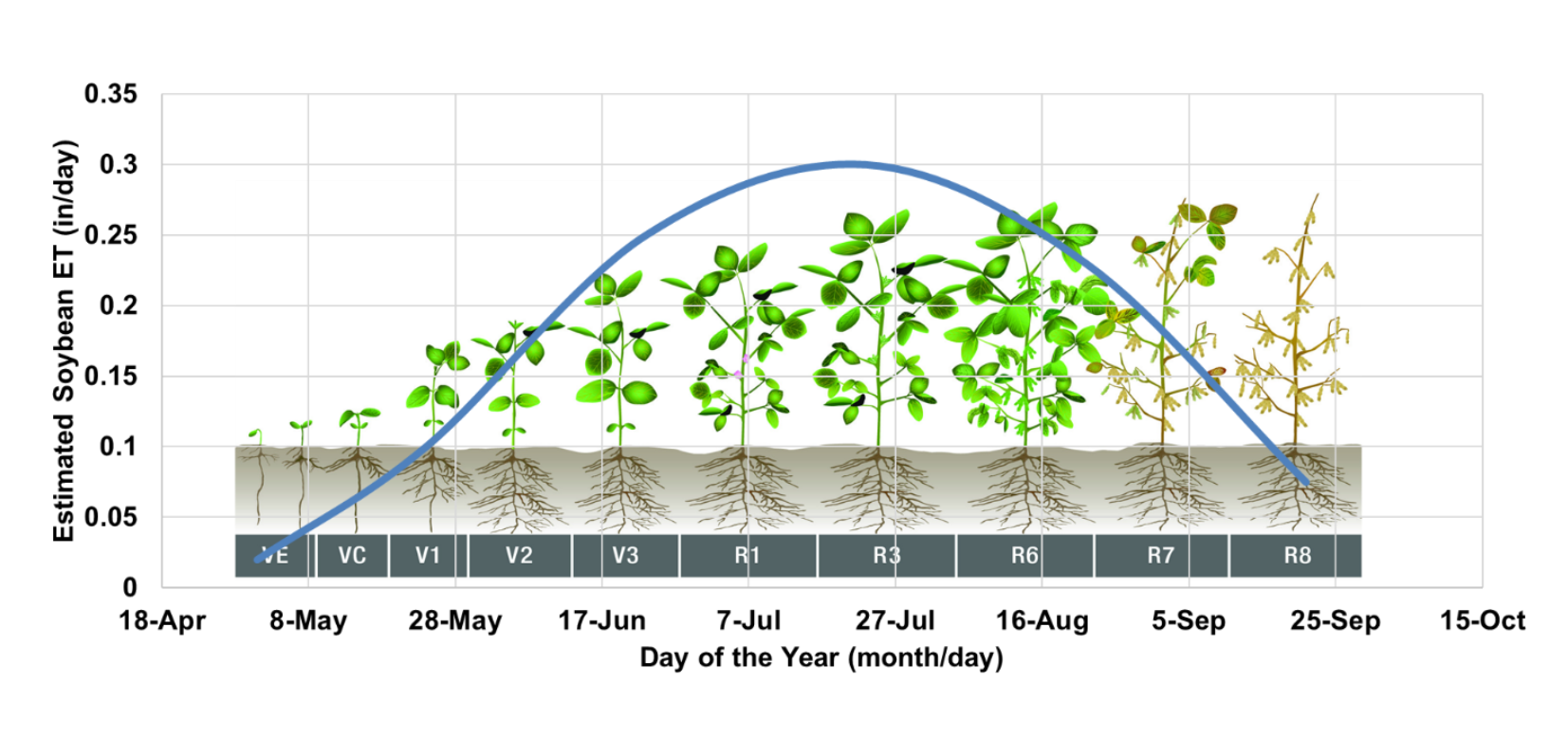
- Soybean water use maximizes at full bloom to early pod set growth stage.
- Coupling soybean water use knowledge with a good irrigation schedule or scheduling tool can help maximize profit and water use efficiency.
Crop Water Use
When irrigating soybean or trying to understand how to schedule or manage irrigation, a few things must first be defined about soybean water use:
- How much water does soybean need or use per day?
- How much water does soybean use throughout the growing season?
- When does irrigation need to be applied?
The goal should be to maximize profit per acre while using the least amount of water to do so. Crop water use is generated from the amount of water being lost from the soil through evaporation plus the loss of water that the plants use through transpiration. This is known as Evapotranspiration or Et.
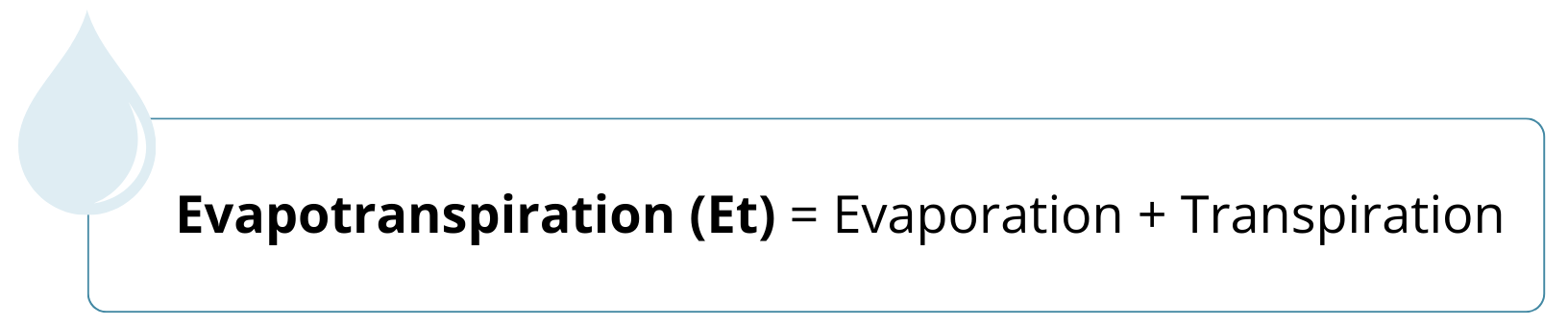
Et rates in soybean can reach 0.3 inches of water per acre per day during times of high temperatures, low humidity, and windy conditions. Knowing that Et can be as high as 0.3 inches per day allows an irrigator to know that, at maximum, 2.1 inches of irrigation/week needs to be applied during peak water use if no rainfall has been received (0.3 inches/day x 7 days).

Soybean Crop Water Use Curve
Evapotranspiration illustrated over the growing season for soybean displays a bell-shaped curve (Figure 1). Thus, water use in early vegetative growth is very low and begins to increase as reproductive growth stages are approached. Peak water use then occurs from full flower through early pod development, R2- R3, and then begins to decrease as the plants mature. Adequate soil moisture is needed through the R6.5 growth stage in soybean to ensure that grain yield is not impacted.
Irrigation Scheduling Tools
Irrigation can be scheduled in many ways. The value of using an irrigation schedule or scheduling tool is to irrigate the most efficient way possible from year-to-year, regardless of varying weather and rainfall.
Each method has its pros and cons; however, each method assists with knowing when to apply irrigation throughout the growing season to meet the water demand. The advantage of sensor-based scheduling over a checkbook method is the ability to evaluate the efficiency or effectiveness of a rainfall event. A few more details of each of these tools are as follows:
1. Checkbook Method:
A check and balance method of supplementing irrigation to meet the daily Et of soybeans when the demand is not being met by rainfall.
Example: If the weekly Et is 1 inch and 0.5 inches of rain were received that week, 0.5 inches of irrigation would need to be applied to meet the demand.
2. Soil Moisture Sensors:
Sensors provide a real-time, in the field measurement of soil moisture.
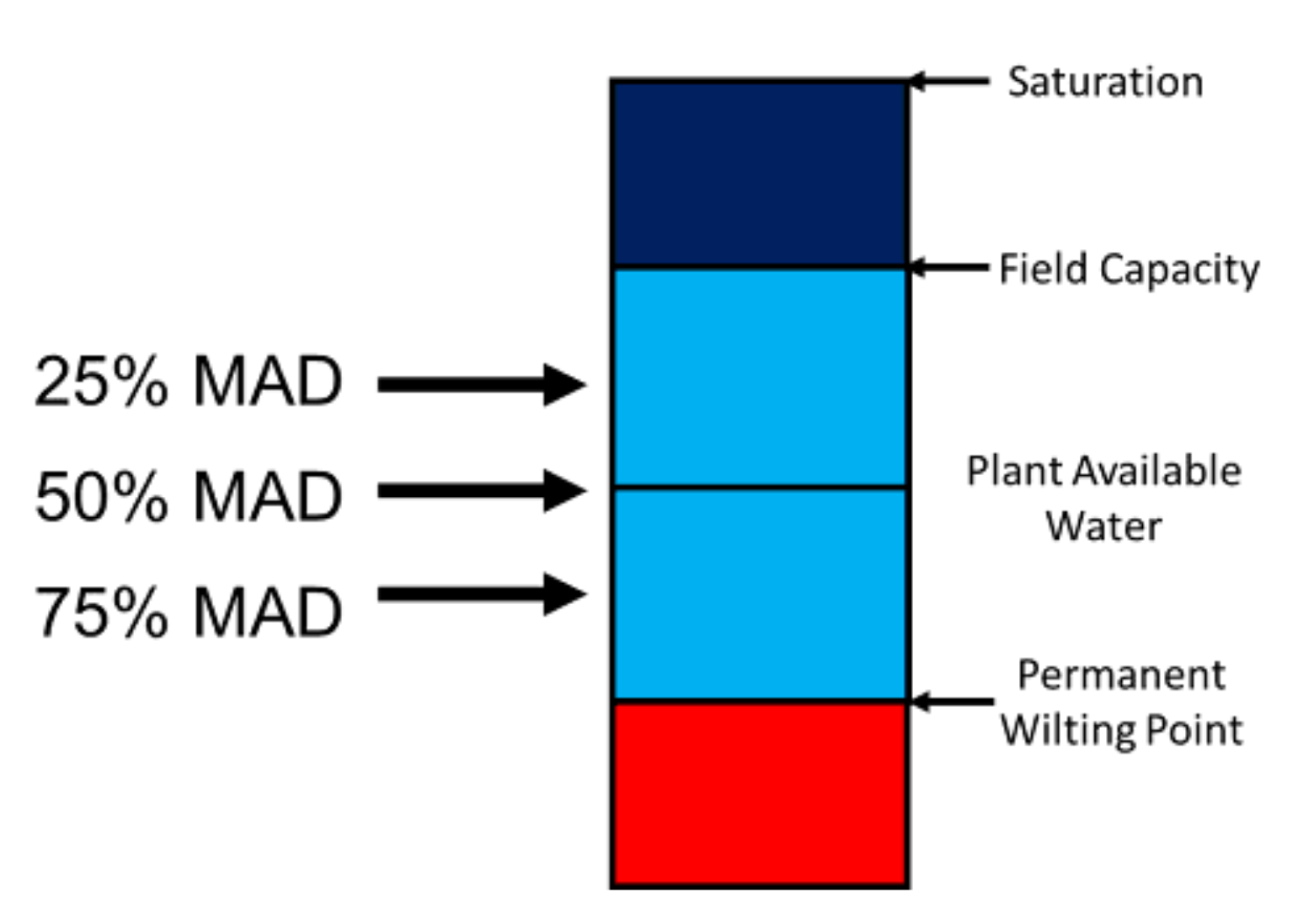
Often, sensor manufacturers recommend that soil moisture is allowed to deplete (Maximum Allowable Depletion (MAD)) between 25 to 50% of the plant’s available water before applying irrigation. Plant available water varies with soil type and water holding capacity but is defined as the difference between field capacity and permanent wilting point (Figure 2).
Conclusion
Understanding when water-sensitive periods in the soybean life cycle occur (R2 to R3) and that approximately 60% of the 20-26 inches of water needed to meet the water use demand of soybean occurs from R3 to R6, irrigation applicators can have a better idea of when to schedule irrigation to maximize yield². Furthermore, coupling this knowledge with an irrigation schedule or scheduling tool can ensure that the under- and over-application of irrigation water is minimal while meeting the crop’s needs.
Author: Michael Plumblee, Clemson University. January 2025
Reference
¹Kranz, W.L., and J.E. Specht. 2012. Irrigating Soybean. NebGuide G1367. University of Nebraska-Lincoln Extension. https://extensionpublications.unl.edu/assets/pdf/g1367.pdf
²Berning D. 2021. Soybean Water Use. Crop Focus. Vol. 13. No. 18. Accessed at: https://www.pioneer.com/content/dam/dpagco/pioneer/na/ca/en/files/articles/DF-Soybean-Water-Use-NA_CA_EN_V1.pdf