Articles

Soybean Nitrogen Nutrition

Understanding soybean nitrogen (N) nutrition is key to producing high-yielding soybean crops.

N Requirements

Soybean Nitrogen Requirement = 4.1 lb N per acre per bushel

Soybean crops require 3 – 4 times the amount of N compared to cereal crops. The plant progressively uptakes the N as development occurs and about 80% of N accumulation occurs after the flowering stage (R1).

Main Sources of N

1) Indigenous Nitrogen Supply

Includes: N leftovers from the previous crop, in-season N mineralization from soil organic matter, N from irrigation water and/or water table, atmospheric dry and wet depositions, and ”starter” fertilizer.

2) Biological Nitrogen Fixation

Can contribute 40-70% of total N requirement depending on soil and environmental conditions. A well-nodulated soybean is foundational for maximizing biological N fixation.

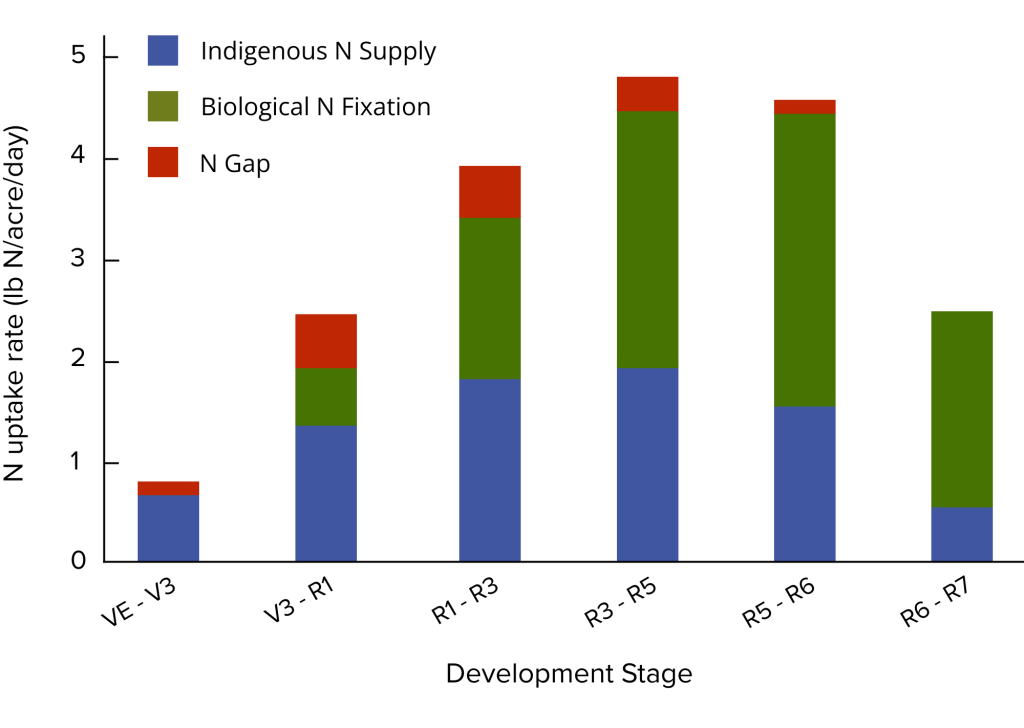
Season Daily N Accumulation Rate: The red portions of the bars indicate the timing and daily amount of N limitation (N gap) in soybean fields that consistently yield more than 70 bu/ac.¹

Emerging N Limitation | Where? Why? When?

Although indigenous N and biological N fixation seem to complement each other to supply N to soybean crops, emerging N limitation cases are appearing in certain scenarios.

Where

Soybean fields with a high yield history of 70 bu/acre.

Why

Low levels of indigenous N supply. Asynchrony between biological N fixation and indigenous N supply results in an N shortage of about 45 lb N/acre. Yield responses to N in high-yielding environments average 9 bu/ac with cases up to 20 bu/ac in soils with very low indigenous N.

When

The N shortage occurs mainly before the seed-filling period (R5), with the largest N gap around flowering (R1). Soil N accounts for most of the N supply until flowering because that’s when the root nodules are being developed and are therefore not fixing much N. The indigenous N supply sometimes gets depleted while biological N fixation is unable to contribute to total N needs. However, some strictly no-till systems can benefit from 30 lb N before planting.²

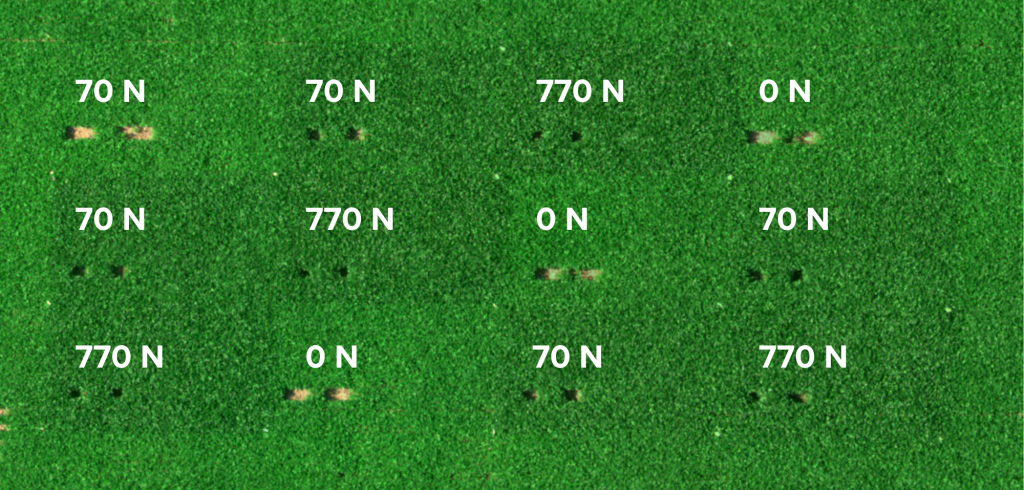
Drone image of a soybean field in Nebraska with 9 bu/ac of N limitation and a 6 bu/ac response to 70 lb N at flowering. Darker squares denote plots with 70 lb N at flowering and 770 lb N split across stages (V3, R1, R3, R5).

Detecting and Overcoming N Limitation

Currently, there is no research-based diagnostic tool to test N limitation in soybean. If the soybean field consistently yields less than 70 bu/ac, it should not require N fertilizer to raise the yield. Instead, several other early-, mid- and late-season management practices can be adjusted before looking into N.

Total N accumulation in a mature soybean crop that yielded 70 bu/ac.3,4,5,6

Action Step

N fertilizer can be applied to high-yielding soybean crops to combat N limitation.

Consider:
  • Soybeans require 4.1 lb N/ac/bu produced (total).
  • Apply at flowering when N gap is highest.

How can extra N raise yield when applied at flowering if there is no seed yet?

About 40% of total N uptake is mobilized from vegetation to seeds. Therefore, N accumulation before the seed-filling period is important for achieving high yield. 

Key Takeaways

  1. Soybean crops have two main sources of N supply: indigenous N supply, and biological N2 fixation.
  2. There are emerging cases of N limitation in fields of more than 70 bu/ac and with low levels of indigenous N supply.
  3. N limitation is caused by asynchrony between biological N fixation and soil N supply in high-yielding environments.
  4. Currently, there is no research-based diagnostic tool to test N limitation in soybean. 

Author: Nicolas Cafaro La Menza, University of Nebraska-Lincoln, July 2025. 

Read the factsheet here. 

References

1.Cafaro La Menza, N., Monzon, J.P., Lindquist, J.L., Arkebauer, T.J., Knops, J.M., Unkovich, M., Specht, J.E. and Grassini, P., 2020. Insufficient nitrogen supply from symbiotic fixation reduces seasonal crop growth and nitrogen mobilization to seed in highly productive soybean crops. Plant, Cell & Environment, 43(8), pp.1958-1972. https://doi.org/10.1111/pce.13804

2. Kendall, M.A., Mourtzinis, S., Gaska, J.M. and Conley, S.P. 2025. Nitrogen fertilizer improves no-till soybean seed yield. Crop, Forest & Turfgrass Management, 11(1), Article e70040. https://doi.org/10.1002/cft2.70040

3. Bender, R.R., Haegele, J.W. and Below, F.E., 2015. Nutrient uptake, partitioning, and remobilization in modern soybean varieties. Agronomy Journal, 107(2), pp.563-573. https://doi.org/10.2134/agronj14.0435

4. Cafaro La Menza, N., Monzon, J.P., Specht, J.E., Lindquist, J.L., Arkebauer, T.J., Graef, G. and Grassini, P., 2019. Nitrogen limitation in high-yield soybean: Seed yield, N accumulation, and N-use efficiency. Field Crops Research, 237, pp.74-81. https://doi.org/10.1002/csc2.70033

5. Salvagiotti, F., Cassman, K.G., Specht, J.E., Walters, D.T., Weiss, A. and Dobermann, A., 2008. Nitrogen uptake, fixation and response to fertilizer N in soybeans: A review. Field Crops Research, 108(1), pp.1-13. https://doi.org/10.1016/j.fcr.2008.03.001

6. Salvagiotti, F., Magnano, L., Ortez, O., Enrico, J., Barraco, M., Barbagelata, P., Condori, A., Di Mauro, G., Manlla, A., Rotundo, J. and Garcia, F.O., 2021. Estimating nitrogen, phosphorus, potassium, and sulfur uptake and requirement in soybean. European Journal of Agronomy, 127, p.126289. https://doi.org/10.1016/j.eja.2021.126289