Take Home Messages
- Each variety has specific strengths and weaknesses for a given environment.
- Important factors to consider include maturity group, herbicide traits, stress tolerance and yield.
- Diversifying soybean genetics will help minimize production risk.
Introduction
Soybean variety selection is one of the most critical and complex decisions that soybean farmers make. There are several factors to consider, and selecting a variety that is a poor fit for a given field can reduce a farmer’s profit, based on yield variation in state variety tests. In addition to yield potential, it is necessary to strategically diversify genetics to include the correct range of maturities and herbicide tolerance, and avoid stresses specific to the field site. To minimize risk, it is advised to use multiple varieties that are adapted to the growing region as this will have a significant effect on the actual yield achieved. This paper will outline each decision factor when choosing soybean varieties and include action steps to aid producers in the variety selection process.
MATURITY GROUP (MG)
Why is maturity group selection so important?
The maturity group of a variety influences how much vegetative growth the plant will develop before flowering, when it will flower, when it will enter pod-set, and the length of frost-free days that the plant will need in order to complete its life cycle.
How Are Maturity Groups Determined?
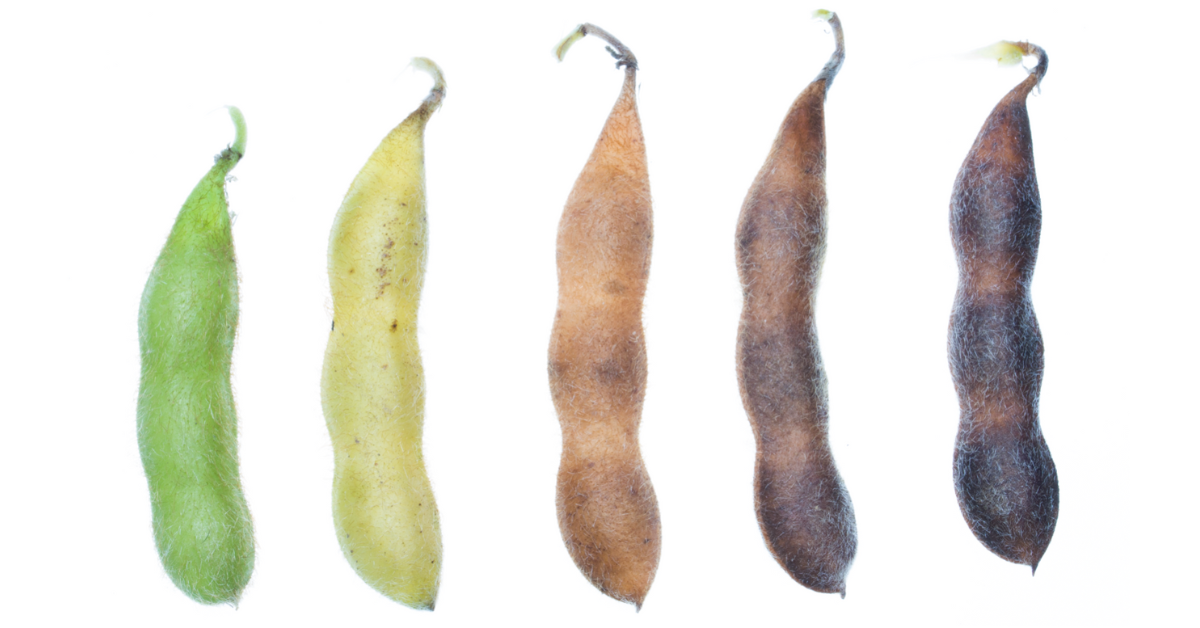
Soybean flowering is typically triggered when the day-length shortens to a certain number of hours. This is known as the photoperiod effect. Soybean development is mainly driven by photoperiod and heat units. To categorize differences in maturity, soybeans in the U.S. are divided into maturity groups (MG) ranging from 00 (planted in the northernmost states) to 8 (planted in the southernmost states). Maturity groups are assigned by individual companies; therefore, maturity dates of varieties with similar MG from different companies may vary. Each MG represents approximately 10 days difference in maturity. Maturity groups can be further divided into relative maturities with each decimal representing circa one day. Therefore, a variety with a relative maturity of 3.0 reaches the mature growth stage (R8) about five days earlier than one with a relative maturity of 3.5. Growth and development is also affected by temperature and stressors; therefore, days to maturity will depend on planting date and the surrounding environment during the season.
How Are Different Maturity Groups Used Between The Northern And Southern United States?
For example, producers in the mid-south are using an early soybean production system (ESPS) that entails planting an early-maturity variety early in the season to avoid late summer heat and drought. In the south, double-crop soybeans planted after small grain harvest (planted from mid-June through early July) may require an adjustment in MG selection, as a later maturity may be beneficial to ensure that leaf area requirements are met. In northern regions, the same variety selected for a full season system may not mature before frost; therefore, an earlier maturing variety is required. In summary, there are caveats for each growing region of the country and MG selection should be based on the MG that has proven to be most effective in the region.
What Should Producers Consider When Selecting Maturity Groups?
Most importantly, one needs to select the proper soybean maturity that will: 1) develop adequate leaf area, 2) position the critical pod and seed development stages into the least stressful time of the year, and 3) mature before frost (Figure 1).

ACTION STEP: Maturity Group Selection
Select an MG adapted to your area. In the Upper Midwest, an MG2 should be the best option for the region, while in the mid-south an MG5 will fit more appropriately. Nonetheless, adjustments can be made when identifying problems in the region. For instance, selecting mid-to-late MG4 varieties have helped increase yield potential in the mid-south; however, comparing MG4 and MG5 varieties for resistance or tolerance to southern root-knot nematodes between the two maturity groups could lead to more varieties to choose from and both would still fit well in the region.
HERBICIDE TRAITS
What About Herbicide Tolerance Traits?
This should be the next step when narrowing down variety options. There are several trait packages on the market for herbicide-tolerance that can be used alone or in combination for better weed control. Most soybean varieties are GMO, but there are still conventional varieties available for the GMO-free market.
Which Herbicide Tolerance Traits Are Available?
Included is a chart clarifying various trait packages available and the herbicide(s) that each trait is resistant to (Table 1). Please note that conventional soybean varieties are not universally resistant to any of the herbicides on this chart, but within each trait package there is variability in varietal sensitivity to metribuzin and sulfonylureas, of which some varieties may have natural tolerance even if they are non-GMO.
Table 1. Soybean Herbicide Tolerance Trait Packages Available
| 2,4 D choline | Dicamba | Glufosinate | Glyphosate | HPPD | SU | Metribuzin | |
|---|---|---|---|---|---|---|---|
| Conventional | |||||||
| Enlist E-3 | X | X | X | ||||
| GT27 | X | X | |||||
| GTLL27 | X | X | X | ||||
| Libertylink | X | ||||||
| Metribuzin | X | ||||||
| Sulfonylureatolerant STS | X | ||||||
| Xtend | X | X | |||||
| XtendFlex | X | X | X |
What Are The Most Important Factors In Herbicide Tolerance Selection?
When deciding which herbicide tolerance traits to use, be sure to consider drift potential for neighboring crops. In some regions where inversions or physical spray drift is common, consider your own crop’s safety regarding potential drift from neighboring fields. Plant-back restrictions for the subsequent crop may be a concern in some cases, especially when specialty crops are included in the rotation. Most importantly, rotating herbicide modes of action (MOA) is one of the best ways to prevent development or persistence of herbicide-resistant weeds.
ACTION STEP: Selecting Herbicide Traits
Match the herbicide trait with the weeds present in the field, paying close attention to herbicide-resistant weeds and local spraying restrictions. Select varieties that will tolerate specific herbicides necessary for better weed control. In addition, it may be necessary to select varieties that are tolerant to older herbicides such as metribuzin. Adding another mode of action to a pre-emergent package will help prevent the weeds from building resistance to herbicides. In some regions, even if you do not plan to use a particular herbicide, consider selecting traits that will limit injury from off-site herbicide movement during application on nearby fields.
STRESS FACTORS
Which Disease And Insect Tolerance Genes Are Most Important?
Soybean varieties are often rated for many common biotic stressors either on a numerical scale or categorically (R=resistant, MR=moderately resistant, MS=moderately susceptible, S=susceptible). Varieties rarely have complete tolerance to a disease or pest; instead, the numerical scale conveys the level of tolerance/survivability. The type of ratings provided by the seed companies can vary depending on the prevalent diseases in various regions of the country. For example, soybean varieties grown in the north will have a rating for white mold while southern varieties will have a rating for frogeye leaf spot. On the other hand, nearly all soybean varieties have ratings for sudden death syndrome (SDS) and Phytophthora root rot as these diseases are a problem throughout the country. In addition, nearly all varieties are also rated for soybean cyst nematode (SCN) and southern rootknot nematode (Figure 2). Tolerance to insect pests such as aphids, spider mites, or red-banded stink bugs is harder to quantify.

ABIOTIC STRESS FACTORS
What About Non-Living Stressors?
Abiotic stresses include weather related conditions such as drought and flooding. While there are likely varietal differences in the ability to tolerate drought or flooding, these ratings are typically not provided by seed companies; however, ratings may be available on a regional basis from some land-grant universities.
Other abiotic stresses include iron deficiency chlorosis (IDC) (Figure 3) and chloride toxicity. There are varieties that are tolerant of both conditions. Soybean varieties can be classified as a chloride ‘includer’ or ‘excluder’. Roots of soybeans that are chloride excluders have the ability to exclude chloride salts, preventing uptake, while includers do not have this ability. While both ‘includers’ and ‘excluders’ can be affected by high soil chloride, it is essential to plant an excluder variety in high chloride conditions. This may be necessary in locations where chloride is in the water due to saltwater inundation or intrusion or when large amounts of potassium chloride fertilizer has been applied.

ACTION STEP: Biotic and Abiotic Stress Factors
What are the yield limiting biotic or abiotic stresses that can drive variety selection in the field? Will the site need a variety with tolerance or resistance to iron deficiency chlorosis (IDC) in alkaline soils, high chloride content in irrigation water, southern root-knot nematode pressure, and the presence of diseases like taproot decline and white mold? Look for information on variety resistance with your seed company or connect with your local extension agent, consultant, or university specialist for more details on variety resistance to these problems.
YIELD POTENTIAL AND STABILITY
Which Variety Has The Highest Yield?
Yield is not the first criteria in selection because there is no one right or perfect variety. Yield potential can be defined as the highest yield a variety can achieve in a single environment. Yield stability can be defined as how well a variety can perform in variable environments (i.e., soils, management, weather, years). Testing varieties side by side is important to accurately screen for the expression of yield genes.
REPLICATED VARIETY TRIALS
Why Are University (Or Public) Variety Trials Important?
As varieties, environment, and production practices change, university yield trials are important for unbiased results across different states and different regions within individual states. University variety testing programs utilize two methods to evaluate variety yield performance and stability, including replicated small-plot trials and larger scale on-farm demonstrations. The majority of soybean varieties become unavailable within one to three years. The quick turnover limits the amount of data that can be observed and makes it necessary to continue testing and evaluating varieties each year.
How Do University Variety Trials Ensure That The Data Is Reliable?
Variety plots in replicated small plot trials usually are designed with three or four replications within a field. The randomized plots account for environmental differences such as soil type and fertility within a single field. Data from replicated plots can separate varieties based on yield using statistics. Predominantly, universities separate varieties using least significant difference (LSD) values that give a 90% or 95% confidence factor. If two varieties have a yield difference larger than the LSD, the yield difference is considered real (within the confidence interval) and not due to random chance. These variety tests may also be duplicated over several environments within the same year, adding more confidence to the data.
What About On-Farm Variety Demonstrations?
Soybean varieties are also evaluated side by side on producers’ farms. These demonstrations often consist of the most widely adopted varieties released from seed companies and university breeding programs. This allows producers to screen for the highest yielding varieties within their particular soil types and production practices. Trials may be established on multiple farms across a state or multiple states, allowing for evaluation of yield stability across multiple environments.
Where Can University Variety Data Be Found?
Data from university variety trials and on-farm demonstrations are published each year by individual universities. These trial results can be found in various electronic formats on university websites and, in some cases, hard print copies can be found at county extension offices. Online variety selection websites are new tools that universities are developing that allow sorting for specific criteria such as yield and stress tolerance.
ACTION STEP: Yield
After narrowing the MG, herbicide traits, and any biotic or abiotic stressors in the field, start looking at varieties with high yield potential in environments like yours. Since the environment can change year to year, know that it is important to look at variety trials across multiple locations and even years if possible to determine variety yield stability. The varieties that consistently yield toward the top of most locations and growing seasons should have the best probability of high yields in future growing seasons.
Other Variety Considerations
After considering the above characteristics, review the following considerations before making a variety selection decision:
Lodging: Variety genetics and production environment dictate standability problems. Soybean planted at higher seeding rates or in irrigated or high fertility fields are more susceptible to lodging due to taller plant growth. If this is a concern, select varieties with a good lodging score.
Shattering: Some varieties shatter more readily than others, although this is not a large concern with modern genetics. Pod shattering is generally associated with harvest delays, so selecting varieties with a good shattering score is important under such conditions.
Seed Cost: Higher-yielding varieties might not be the most profitable ones, so balancing the cost of seed with yield potential is important in maximizing overall profits. Selecting variety traits based on field-specific stresses can help cut down the cost of seed. Previous Year’s Seed Quality: Consider seed quality, especially in years following a challenging seed fill period in the previous crop, as part of your selection decision to minimize poor germination and plant stand issues.
Following Crop: The cropping sequence for a given field might also dictate variety selection. In the northern region, selecting a later MG variety in fields where early planting can be achieved can maximize yield and profits by optimal utilization of the growing season. In a double cropping system, a different variety may be selected than in a full-season cropping system in terms of MG and other desired traits. For example, in areas where small grains or cover crops are planted in the fall, producers may choose to plant a relatively earlier maturing variety to facilitate planting in the same year.
Minor Characteristics: Other soybean characteristics such as flower color, hilum color, seed size, hypocotyl length, and leaf shape, usually should not factor into your decision for selecting the most appropriate variety for your farm. There are a few expectations for food grade products, such as seed and hilum color, as well as seed size, which can be important factors.
ACTION STEP: Other Considerations
If any of these apply to the field site, eliminate varieties that do not fit the criteria.
SUMMARY
The process of selecting a variety starts in identifying the Maturity Group (MG) adapted to the location followed by using information on the field related to problems that can limit yield or make it not profitable, such as, type of weed or weed herbicide-tolerance, history of soil pathogens, soil pH or electroconductivity, and possible nematode presence. Second, look at available databases with yield performance of varieties across the region with multiple years to evaluate yield stability of the varieties grown in the area.
Using the step-by-step guide described above, a farmer can find a shortlist of varieties from a few different companies which fit all disease and herbicide trait criteria and possess good yield stability over time. The final step in the process is discussing the varieties with a regional soybean specialist to ensure that there are truly different genetics in a farmer’s selections, not the same genetics marketed with a different company designation.
RESOURCES:
https://crops.extension.iastate.edu/encyclopedia/ soybean-variety-selection.
https://soybeanresearchinfo.com/agronomics/ variety-selection/.
https://soybeanresearchinfo.com/resources/ resource-library/variety-trials/.
https://www.pubs.ext.vt.edu/content/dam/pubs_ext_ vt_edu/424/424-040/424-040.pdf.
https://extension.sdstate.edu/sites/default/ files/2020-03/S-0004-06-Soybean.pdf.
https://ncsoy.org/varietyselector/.
https://www.lsuagcenter.com/topics/crops/ soybeans/variety_trials_recommendations.
Authors: Jenny Carleo, North Carolina State University; Daniela Carrijo, Pennsylvania State University; Shaun Casteel, Purdue University; Shawn P. Conley, University of Wisconsin, Madison; Eros Francisco, Auburn University; David Holshouser, Virginia Tech University; Hans Kandel, North Dakota State University; Jonathan Kleinjan, South Dakota State University; Chad Lee, University of Kentucky; Mark Licht, Iowa State University; Laura Lindsey, The Ohio State University; Emma Grace, Matcham University of Florida; David Moseley, Louisiana State University; Mike Mulvaney, Mississippi State University; Seth Naeve, University of Minnesota; Emerson Nafziger, University of Illinois; Michael Plumblee, Clemson University; Giovani Preza Fontes, University of Illinois; Jeremy Ross, University of Arkansas, Maninder “Manni” Singh, Michigan State University; Rachel Vann, North Carolina State University.