A Systems Approach to Early Planting in the Northern United States
Take Home Points
– Early soybean planting can improve yields or at minimum lower the losses associated with delayed planting.
– Soybeans seem to be more forgiving than corn to non-ideal planting conditions and uneven plant stands.
– Other management decisions can be tweaked as part of a systems approach to maximize the benefits of early soybean planting.
Early Planting Soybean
Soybean planting date has been shown to have a large impact on a crops’ yield potential. Early planting is particularly important in the northern US where the length of the growing season is one of the greatest limiting factors. However, early planting might not be the silver bullet in itself and a systems approach is warranted to maximize potential benefits of early soybean planting. This approach focuses on managing the entire production system, including genetics, environment, and management practices (i.e. G x E x M) in order to mitigate risks associated with early planting while maximizing yields and minimizing production costs. Here are some factors to consider as farmers move more towards early soybean planting.
Choosing a Planting Sequence
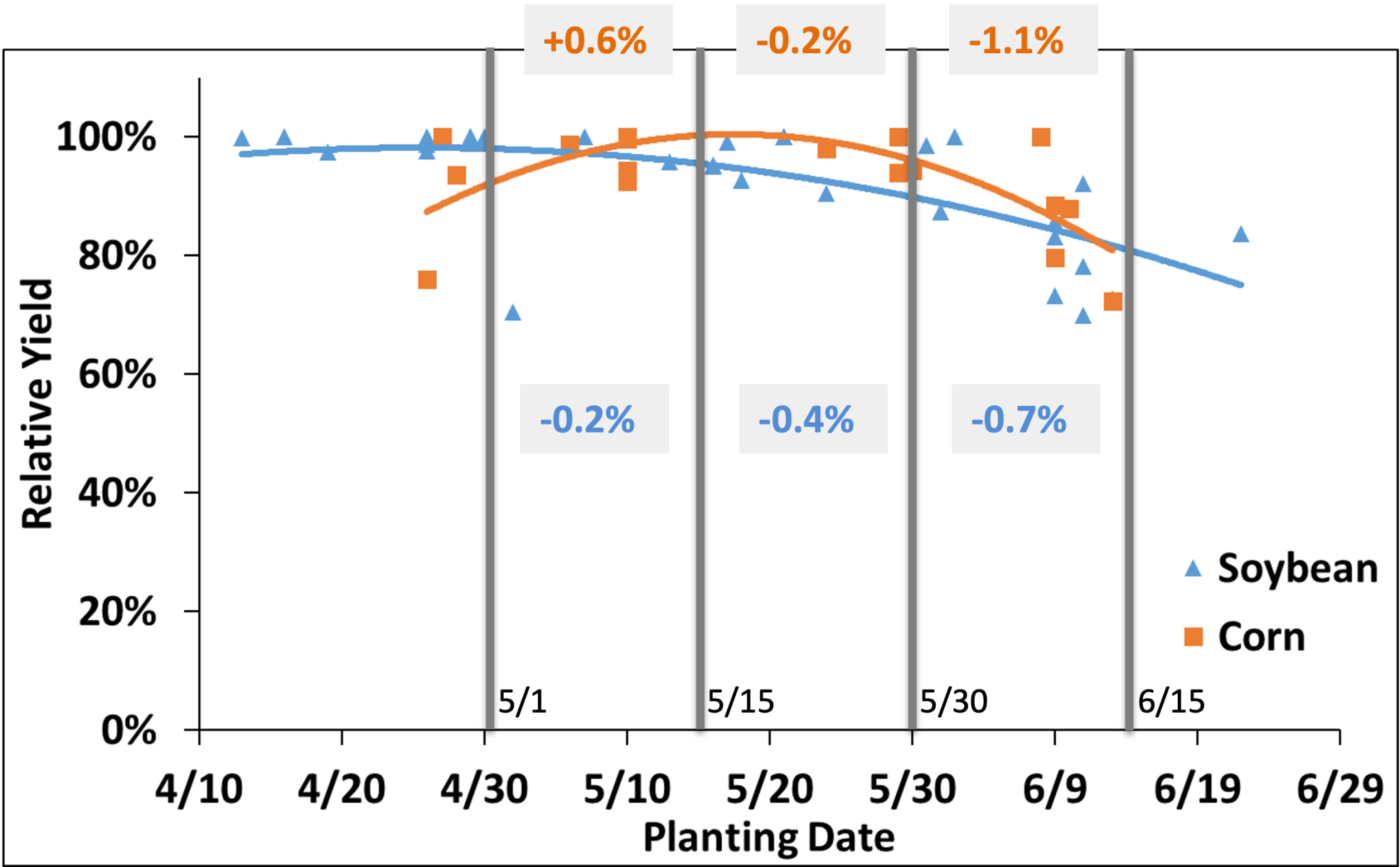
Every spring, farmers have to decide whether to prioritize planting corn or soybean due to limitations involved with labor, equipment availability, farm size, crop rotation, and field location. Our research from Michigan has shown that early soybean planting can improve yields in some situations, or at minimum lower the losses associated with delayed planting (Figure 1).
Figure 1. Data from Michigan field trials in Lansing and Richville from 2018-2024 showing the importance of timely soybean planting. Daily rates of yield loss or gain (percentages in grey rectangles) are shown between May 1 to 15, May 15 to 30, and June 1 to 15 for soybean (blue) vs corn (orange).
Importantly, we did not observe yield loss while planting into non-ideal field conditions (cool and/or wet soils). This was in contrast to corn response where a yield penalty was observed when we pushed for early season planting. These data suggest that soybean are more forgiving than corn in dealing with early season planting conditions, probably due to their ability to compensate for relatively uneven plant stands by branching out. Yield in corn is more dependent on uniformity of plant stands throughout the field, hence can suffer yield losses from early season planting. Overall, our data suggests that farmers can prioritize soybean planting until early May in Michigan and then switch to corn plantings to maximize system level profits.
Our data also showed a smaller yield increase under early planting than anticipated, suggesting other management practices might need to change based on planting date in order to maximize yield and profits from early plantings or minimize losses from delayed planting.
Management Decisions Based on Planting Date
When deciding to plant early, farmers have to think about several other factors such as adjusting varietal maturity, tillage and planting practices, seeding rate and treatment, fertility, pest management, and harvest and crop rotation. Research is still ongoing regarding the design of an ideal system for early soybean planting, but some considerations include:
Variety Maturity
Research has shown that the benefits of early soybean planting can be improved by using varieties that are a half to full maturity group longer than what you would typically plant for the area (Figure 2). These longer varieties under early plantings increased the amount of growing degree day accumulation during vegetative and reproductive stages and resulted in a greater number of seeds per unit area without reducing seed weight, leading to yield increase.
Figure 2. The effect of planting date and maturity group selection on soybean yield in Mason, Michigan. Orange colors indicate higher yields while green colors indicate lower yields. The blue line represents a maturity group of 2.5, which is recommended for a typical soybean planting timing in Mason, Michigan.
Seeding Rate & Seed Treatment
Data has shown that early planting may allow for a slightly lower plant population due to increased branching and node development (Figure 3). The use of a seed treatment can improve plant stands but the impact on yield is minimal and location dependent. The cool and wet soil conditions during early planting can result in stand loss and may require either use of seed treatment or a higher seeding rate. Consider repair-plant options instead of a replant if plant stands are below 60,000-70,000 plants/acre.
Figure 3. The effect of planting date on the agronomic and economic optimal seeding rates (AOSR and EOSR) under 2 soybean prices ($9 and $13 per bushel). The green text highlights the difference in seeding rates between economic and agronomic optimum rates. Data is from 15” rows under conventional tillage.
Planting Method & Row Spacing
Data from 8 site-years in Michigan has shown minimum yield losses while using less-precise planting equipment (e.g. drilled or broadcast incorporated), probably due to a soybean plant’s ability to compensate for uneven and lower plant stands. Benefits of narrow row spacing (≤15”) was still evident in our data even under early planting conditions compared to 30” rows.
Other Considerations
– Choose varieties with high warm and cold germ scores, early-season vigor, and tolerance to sudden death syndrome (SDS).
– Avoid planting in wet soils to limit compaction and do not plant if there is a forecast of cold rain within 24 hours.
– Implement a robust weed control strategy, including PRE and POST herbicide applications.
– Consider adjusting your combine settings, as early planted soybean plants might pod closer to ground and have thicker stems.
References
Siler, T. B., & Singh, M. P. (2023). Soybean seeding rate and seed treatment that maximize yield and profitability based on planting date. Agronomy Journal, 115(2), 759-769. https://doi.org/10.1002/agj2.21253
Siler, T. B., & Singh, M. P. (2022). Optimal soybean maturity group selection is influenced by planting date in northern production systems. Crop Science, 62(6), 2462-2475. https://doi.org/10.1002/csc2.20829