Take Home Messages
- Current soybean varieties efficiently respond to their environment through branching, and therefore can produce maximum yields at relatively low plant densities.
- Southern soybean farmers may achieve maximum yields with less than 100,000 plants per acre, while Midwest farms may require 100-125,000 plants per acre. North Dakota and Northwest Minnesota farms may require more than 150,000 plants per acre.
- Ensuring maximum yields requires farmers to plant at rates higher than the minimum required plant density. Recommended seeding rates vary considerably, but are often about 25% higher than the target plant population.
Introduction
Soybean seed costs are about 40% of the variable costs in soybean production, and optimizing seeding rate will help to produce high yields without overspending on variable costs. Generally, soybeans require higher seeding rates and more plants per acre in the Northern United States and in later-planted fields across the US. Soybean typically requires fewer plants and lower seeding rates for much of the Midwestern and Southern US when timely planting occurs.
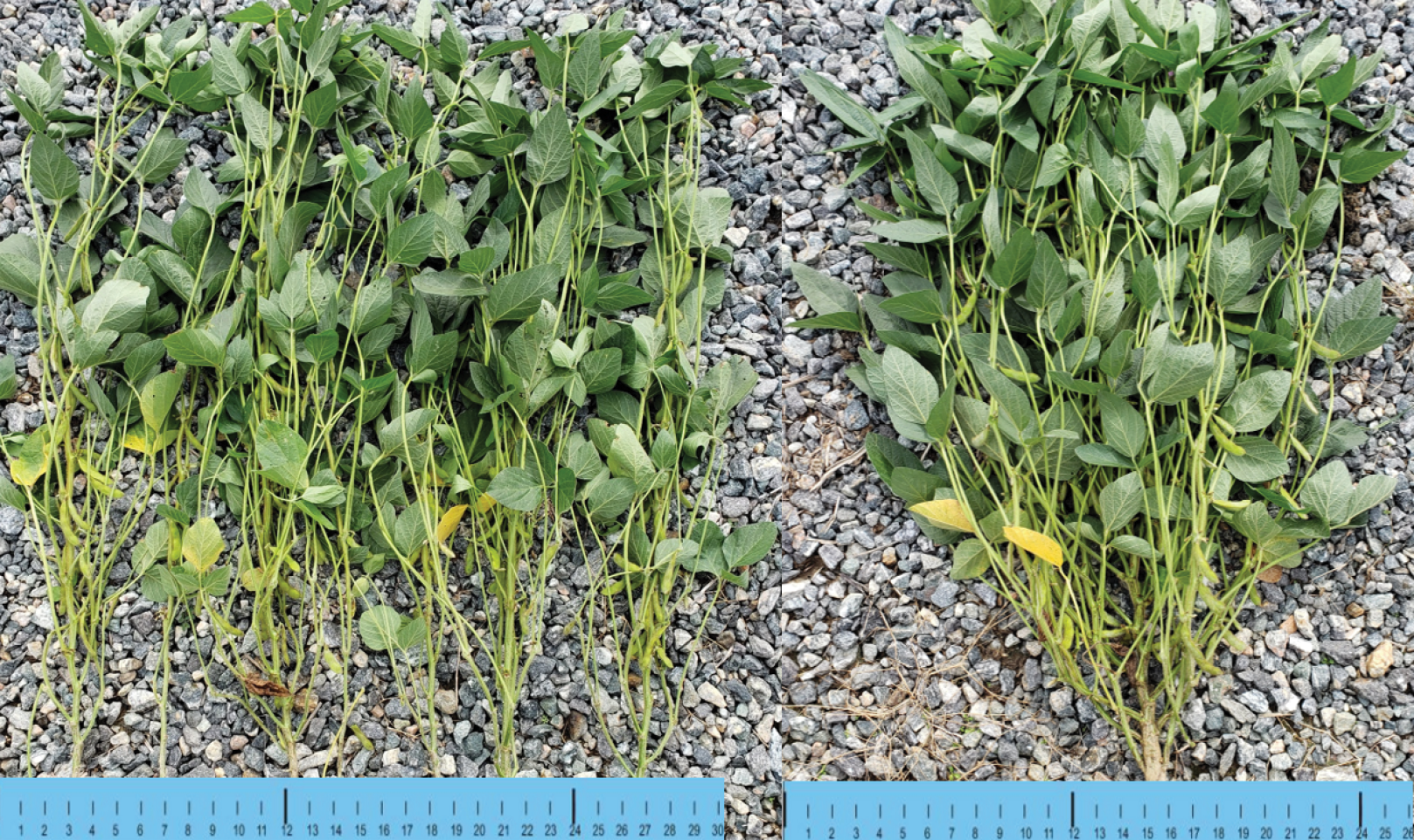
Soybean plants are incredibly flexible at adjusting to a wide range of plant populations (Figure 1). Soybean plants in low populations will produce more branches, more pods and more seeds per plant. Soybean at higher populations will grow taller, produce fewer branches, pods and seeds per plant. Because of this flexibility, soybean can often produce similar seed numbers per acre and similar yields over a wide range of plant populations. Perhaps because of this flexibility, along with experience of anticipated percent establishment, soybean producers in the Midwest report a wide range of seeding rates they use in the region (Figure 2).

Plant Population Density
Plant population density (PPD) is simply the number of plants per acre. Seeding rates must be higher than the expected final stand of soybeans, but how much higher can be a difficult question. Too much or too little soil moisture, suboptimal temperature, improper planting depth, soil salinity, soil pH, insect damage, disease, and lower seed germinability can all decrease emergence. Of these, germination percentage is often the only one we can predict, and the rest of these can be lumped together to come up with an estimate of how many seeds need to be planted to end up with a desired PPD. With good seed (germination of 90% or so) and good planting conditions, dividing desired PPD by 0.8 (multiplying by 1.25) should give a reasonable seeding rate.
Soybean Response to Plant Population Density
Agronomic optimal plant density is defined as the lowest plant density that maximizes yield. Under most circumstances, soybean yield increases with PPD until a point at which yield either plateaus or decreases. Because yield is a function of light that is intercepted by the crop and converted into plant material, yield has a direct relationship with light interception (Figure 3). Light interception by the crop is not maximized at low PPD, which can lead to lost yield. Increased PPD results in more rapid canopy closure.
Yield responses to increased PPD are larger in Northern environments where slower growth limits total, seasonlong light interception. Low plant populations reduce lodging risk but contribute to pods setting lower on the plant, excessive branching, and thick stems that can hinder harvest.
Germinating seeds that are close together in the row can exert more pressure and emerge better, while low PPD’s, with large gaps between seeds, may result in lower stands in crusted soils. This is especially apparent in narrow rows, where seed-to-seed spacing is greater.
Above-optimal PPD leads to tall and spindly plants that are more susceptible to lodging. High PPD may cause yields to decrease in low-rainfall environments because of drought stress. Yield losses due to excessive PPD are relatively rare and are most common when there is lodging or infection with diseases such as Sclerotinia stem rot (white mold).

Researchers have found a wide range of acceptable PPD that maximize soybean yield. In the Southeastern Coastal Plain greater PPD improved vegetative growth at early reproductive growth stages; however, increasing seeding rates above 110,000 seeds/acre did not improve further plant growth later in the growing season. Yields tended to plateau in the mid-South when seeding rate ranged from 70,000 to 130,000 seeds/ acre. In the Midwest maximum yields have required final harvest populations of 190,000 plants/acre but > 95% of the maximum yield was achieved with final populations as low as 105,000 plants/acre. Soybean yields do not vary significantly for a wide range of plant populations in the upper Midwest. In North Dakota and Northwest Minnesota, an established plant population of approximately 150,000 plants/acre is desirable regardless of row spacing.
Economic optimal plant density takes into account crop value (yield x price) and seed cost, thereby maximizing return on seed investment. This economic optimal PPD is reached when the last thousand seeds added to the rate increases the yield just enough to pay for itself; planting more seeds will not increase yield enough to pay the added seed cost. While reducing seeding rates can help save on input costs, growers should not reduce the seeding rate below the amount needed to produce the maximum economic yield. Seed costs can also be reduced by selecting less expensive seed sources (Figure 4).

Seeding Rate Recommendation vs Agronomically Optimum Plant Population Density
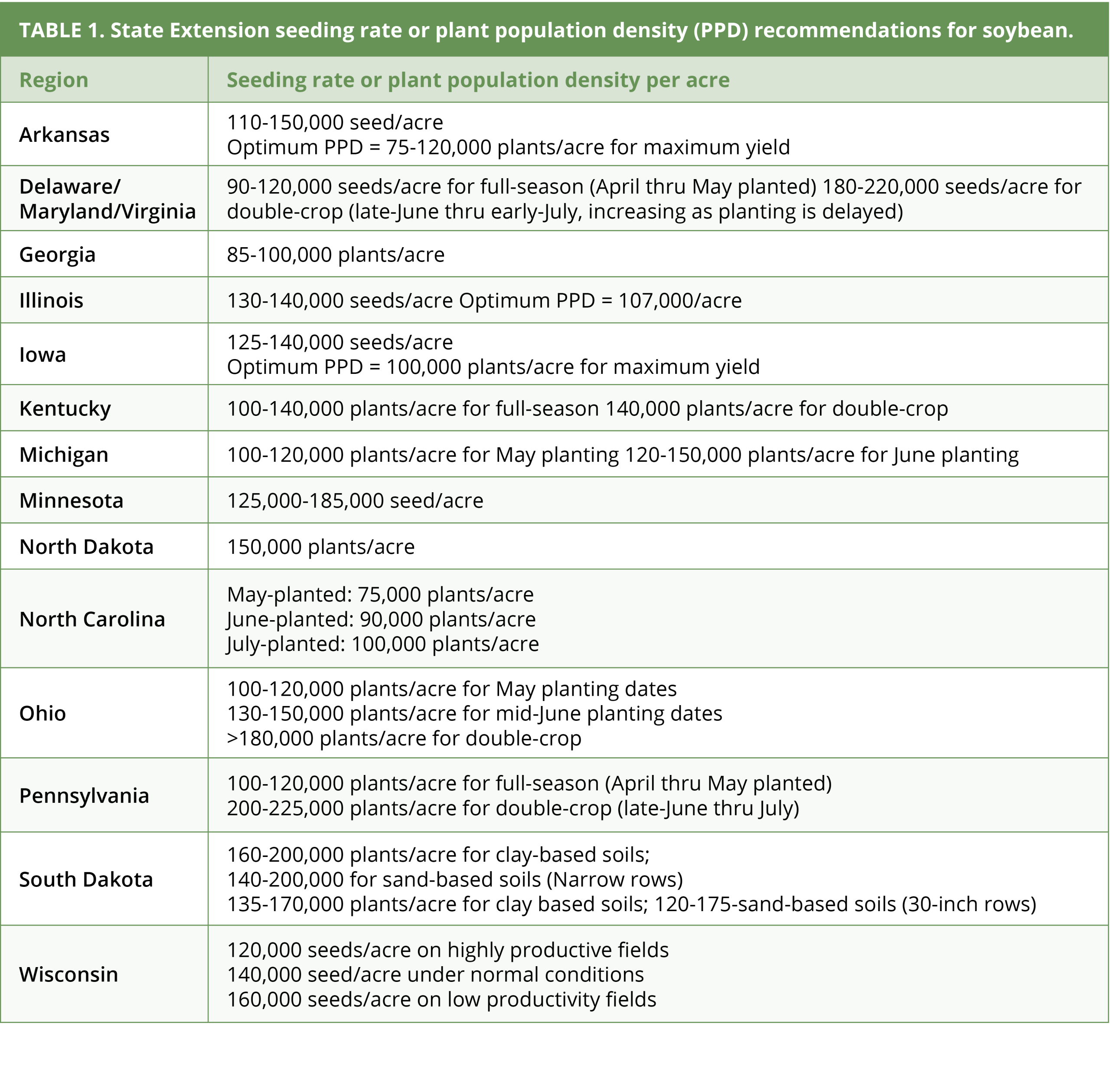
How should a producer identify what seeding rate is best for their management, environmental, and economic situation? A good starting point is to look for local Extension recommendations. Table 1 shows the range and variety of recommendations provided by state Extension soybean specialists. Seeding rates are expressed as live seed (calculated based on germination percent). The early season stand density tends to be about 10% lower than the seeding rate and the final PPD prior to harvest is an additional 10% lower than the early season stand. In order to attain a final stand of 100,000 plants per acre, 133,000 seeds might be required if a producer expects to lose a total of 25% from germination, emergence, and in-season attrition.
Planting into cold and wet soils, planting too deep, or into crust prone conditions also greatly increases losses. Stand losses are higher when seeds are poorly distributed within the row, when populations are high, or in wider rows, due to more inter-plant competition. Losses are reduced with modern planters with row units. These planters may not result in greater yields, but they can lower seeding rates and overall costs. Similarly, fungicide/insecticide seed treatments can decrease losses. If these factors can be predicted, seeding rates should be adjusted proportionally.
Other Seeding Rate Considerations
- Very early and much delayed planting dates may require higher seeding rates.
- For reducing iron deficiency chlorosis, increase seeding rates by 50,000 to 60,000 seeds/acre, which results in reduced chlorosis and increased seed yield.
- Earlier maturing varieties compared with adapted varieties benefit from a higher seeding rate.
- Higher seeding rates can assist in weed suppression; however, row spacing is more important in this regard.
- Lower yielding fields or areas within fields may benefit from increased seeding rates.
Authors: Shawn Conley, University of Wisconsin; David Holshouser, Virginia Tech University; Matthew Inman, Iowa State University; Chad Lee, University of Kentucky; Laura Lindsey, Ohio State University; Mark Licht, Iowa State University; Hans Kandel, North Dakota State University; Jonathan Kleinjan, South Dakota State University; Carrie Knott, University of Kentucky; Seth Naeve, University of Minnesota; Emerson Nafziger, University of Illinois; Jeremy Ross, University of Arkansas; Maninderpal Singh, Michigan State University; Rachel Vann, North Carolina State University.