Planting within optimal planting dates maximizes soybean yield
Planting faster results in more acres planted during ideal planting windows
Research based evidence shows planting speeds up to 11 mph do not reduce yield
While investment in speed planting technology is significant, returns can be substantial
Why Does Speed Planting Matter?
Optimal Planting Window
Every region has an optimal planting window for soybean. In Mississippi, yield loss is 0.4 bu/ac/day after May 1. In Wisconsin, yield loss is 1 bu/ac/day after May 20. Unfortunately, the 5-year average planting progress for Mississippi and Wisconsin soybean farmers is <50% by the end of their respective optimal planting windows. Planting in those optimal windows is often constrained due to weather challenges, farm size, and equipment and labor constraints. Although the optimal planting window in Mississippi is three weeks long, weather generally leaves only about 7.5 suitable days for field work, making planting speed an essential factor to achieve timely crop establishment.
TOP TIP: Make the most of the limited planting dates in your optimal window by speed planting.
Economic Impact
Planting late costs money. At $10 per bushel, delayed planting costs $27.30/ac/wk in MS, for example.
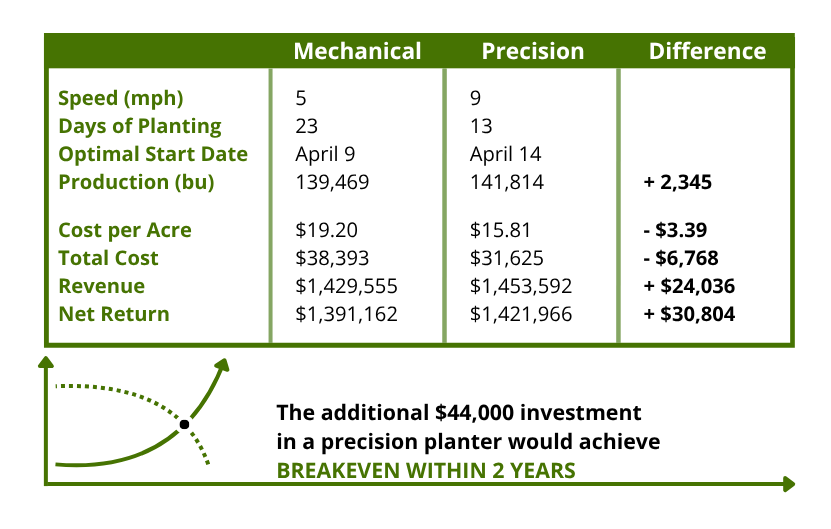
Mississippi State University research also examined the economic implications of the transition from traditional mechanical planters to precision planters. It assumed a 2,000-acre soybean field using a 12-row planter on 38-inch spacing with soybeans at $10.25/bu.
Fast Facts: The more acres planted, the higher the cost savings are for the precision planter. The efficiency gain is primarily due to reduced labor and more acres planted in the ideal window.
Research Trials
Mississippi State University research examined the effects of increased planting speeds on several key performance metrics across several years and different sites. The study compared two planter systems.
Precision Planter: John Deere MaxEmerge 2 row units with Ag Leader SureSpeed + SureForce. Tested at 6, 9 & 11 mph
Mechanical Planter: John Deere 1700 ground-driven mechanical planter with eSet meters. Tested at 6 mph, to represent typical farmer practices
Plant Population & Spacing
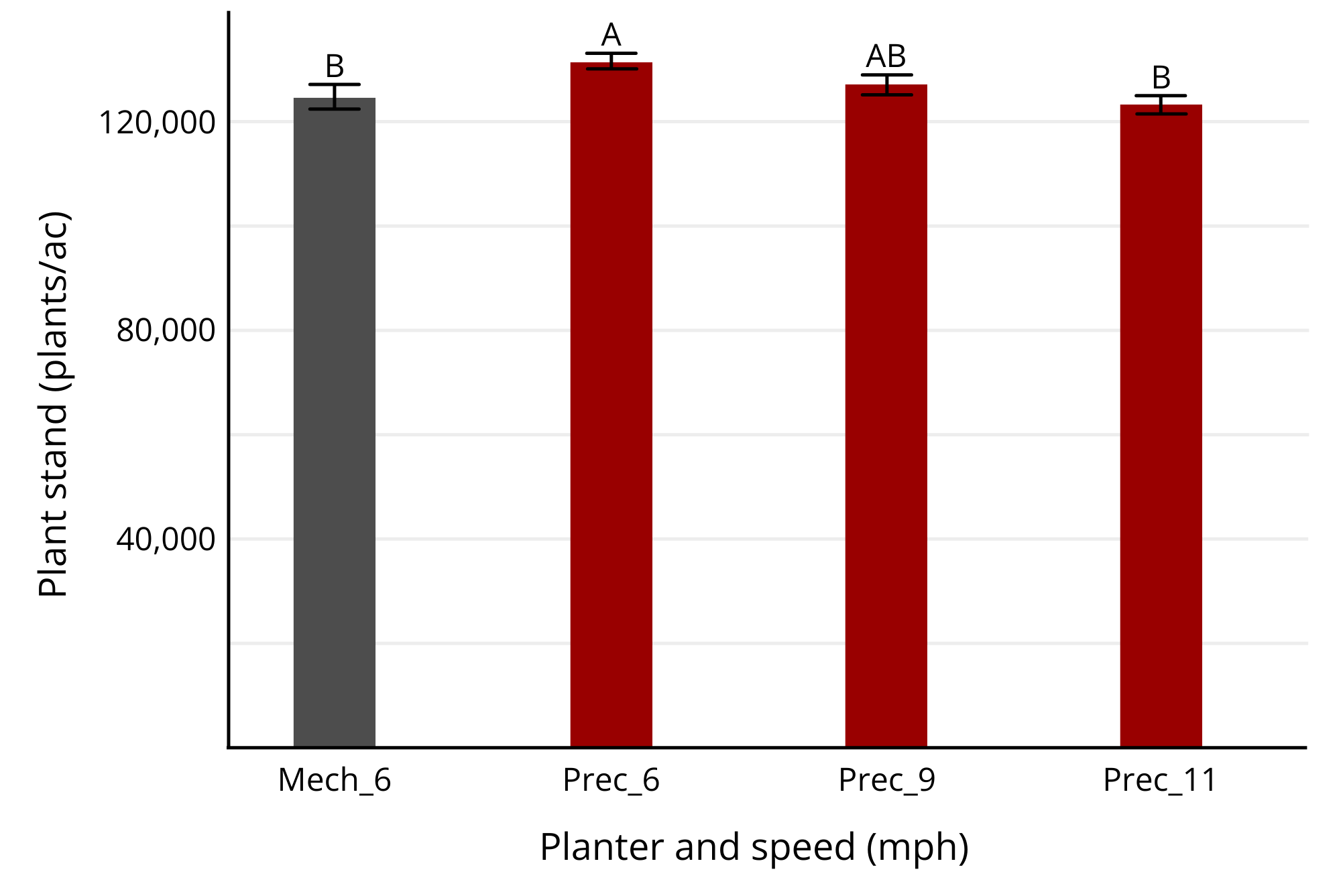
Although higher planting speeds generally lead to a reduced plant population and increased variability in plant spacing, these changes have not translated to yield losses (Figures 1 & 2). Soybean plants demonstrate remarkable ability to compensate for minor variations in spacing when staying within acceptable ranges (>80,000–100,000 plants/ac). At planting rates between 120,000 to 140,000 seeds/ac, plant stands consistently remain above yield-limiting thresholds, even at the highest planting speeds.
Figure 1. Soybean plant stand in 2023 across sites. Different letters represent statistically significant means (p<0.05). Mech_6 = mechanical planter running at 6 mph, Prec_6, Prec_9 and Prec_11 = precision planter running at 6, 9 and 11 mph.
Figure 2. Soybean plant spacing in 2023 across sites. Different letters represent statistically significant means (p<0.05). Mech_6 = mechanical planter running at 6 mph, Prec_6, Prec_9 and Prec_11 = precision planter running at 6, 9 and 11 mph.
Yield Performance
Extensive field trials across Mississippi have found no yield difference between soybean planted with a mechanical planter at 6 mph and those planted at speeds up to 11 mph using a precision planter (Figure 3). This consistency in yield performance has been demonstrated across various soil types and field conditions, suggesting broad applicability of using advanced planting technologies for highspeed planting.
Figure 3. Soybean yield in 2023 across sites. Different letters represent statistically significant means (p<0.05). Mech_6 = mechanical planter running at 6 mph, Prec_6, Prec_9 and Prec_11 = precision planter running at 6, 9 and 11 mph.
Management Considerations
Successful high-speed planting requires attention to field conditions and equipment performance.
Begin at lower speeds and gradually increase as conditions allow, regularly monitoring seed placement and making necessary adjustments.
Soil moisture, field preparation, residue levels, available horsepower and cooling capacity, and terrain all influence optimal planting speed.
Regular monitoring of seed depth and closing wheel performance helps ensure proper implementation of high-speed planting practices.
Obstacles in the field, such as water furrows, require attention when planting at high speed.
Authors:
Mike Mulvaney, Oluwaseyi E Olomitutu, and Brian Mills
Malcomson, A., Mourtzinis, S., Gaska, J., Roth, A., Silva, T. S., & Conley, S. (2024). Planting date and maturity groups effects on soybean yield in Wisconsin. Crop, Forage & Turfgrass Management, 10(2), e70015.
United States Department of Agriculture National Agricultural Statistics Service (USAD NASS, 2024). Available at: https://quickstats.nass.usda.gov/.
Bateman, N. R., Catchot, A. L., Gore, J., Cook, D. R., Musser, F. R., & Irby, J. T. (2020). Effects of planting date for soybean growth, development, and yield in the southern USA. Agronomy, 10(4), 596.
Heatherly, L., Bowers, G., Boethel, D., Baur, M., Rabb, J., Rupe, J., Typer, J., Way, M. O., & Ashlock, L. (1998). Early Soybean Production System Handbook. Office of Agricultural Communications, DAFVM, Mississippi State University.
Olomitutu, O. E., Mulvaney, M. J., Lowe, J. W., Bryant, C. J., Wallace, J., Harper, N., … & Dhillon, J. (2024). Soybean response to high‐speed planting in Mississippi. Agronomy Journal, 116(6), 2817-2826.