The soybean crop needs to encounter various conditions across growth stages to optimize yield. Sensitivity to stress varies across growth stages, resulting in an array of risks, some of which can be mitigated through management. This publication seeks to discuss risk and management options from emergence through seed fill.
Vegetative Growth Stages
Vegetative Stage Emergence (Planting through VE)
Obtaining a stand of sufficient population and uniform distribution is the first step in ensuring maximum soybean yield. Planting at the optimal date and into a proper seedbed will start the crop off right. It is important to seed at a rate that will provide an adequate and relatively uniform stand for your region.

| RISKS THROUGH EMERGENCE | OPTIONS TO MANAGE THE RISKS |
|---|---|
| Poor seed quality/germination including vigor | Adjust seeding rate based on germination stated on seed tag or current germination test. Seed vigor tests may be helpful for very early or late plantings, especially when planting into cool soils. |
| Planting date penalty due to replanting | Plant after crop insurance replant dates begin and before cutoff dates are initiated. |
| Plant death due to freeze or frost event | Select the appropriate planting date for your region. |
| Variable emergence due to variable planting depth, soil water content or residue | Proper planter set up: Seed-to-soil contact is required for good emergence. Check seeding depth and soil moisture depth multiple times each day and especially when changing fields, soil textures, or tillage practices. Residue management is important to promote proper seed-to-soil contact and ensure proper and consistent seed depth. |
| Diseases, insects, nematodes, slugs or wildlife feeding | Use an appropriate seed treatment in fields with a history of pest problems or with early planting dates where cool/wet soils are common. Not all fields need a seed treatment. Residue management is important to minimize slug injury. At-plant nematicides should be used in fields with above threshold levels of plant parasitic nematodes. Exercise proper crop rotation by avoiding continuous soybean rotations to reduce disease and pest issues. |
| Early season weed pressure or herbicide carryover or injury | Weed management is a challenge as herbicide resistance is becoming more common. Start clean, stay clean. The critical weed free period is after the V2/V3 growth stage. Check herbicide label rotational restrictions. Be aware that last year’s growing conditions and soil properties (i.e., pH) can influence herbicide carryover. Follow herbicide labels for preemergent application timing. Avoid sprayer contamination or misapplication of pesticide. |
| Excess soil moisture/flooding or drought/dry conditions | Ensure that fields are ditched and drained to reduce ponding. Apply supplemental irrigation if available to alleviate drought or dry conditions. |
| Soil crusting from extreme rain event or excess tillage, soil compaction, or sidewall compaction | Alleviate compaction using proper tillage tools. Don’t cause compaction by tilling or planting when soils are too wet. Maintaining residue reduces risks associated with soil crusting. |
| Heavy crop residue or rough seedbed preventing uniform seed placement and/or impeding seedling growth | Plant with a properly equipped and adjusted planter at moderate speeds into a well prepared, smooth, seedbed. This will prevent planter bounce and variable planting depth in no-till/reduced till fields and will ensure uniform seed placement. |
| Cool soils leading to slow or limited development of photosynthetic capacity | Plant when field conditions are optimal (i.e., soil temperature and soil moisture) and the 10day forecast and calendar date are conducive to supporting germination and emergence. |
| Sandblasting from dry, windy conditions | Maintaining residue through reduced or no-tillage will minimize or eliminate this risk. Supply supplemental irrigation, if available and necessary, to meet crop water use demand, activate herbicides, and reduce sandblasting. |
| Seedling death due to salt burn | Do not apply in-furrow applications of fertilizer that have a high salt index. |
| MISCONCEPTION | REALITY |
|---|---|
| Soybean plants need to have uniform emergence and uniform spacing “a.k.a. the picket fence” to maximize yield. | Emergence uniformity is not critically important in soybeans. Research has shown planter downforce did not impact grain yield regardless of tillage, soil texture or gauge wheel type. Rate of emergence over four days was altered but did not result in yield differences. Additional research has shown no difference between random drop and precision planting until seeding rates were reduced to 40,000 seeds per acre. |
| Seed size of planted seed influences end of season crop yield. | Seed size can influence percent emergence (smaller seed size increased emergence 10%), but as long as an adequate stand is established, there is no influence of planted seed size on yield. Effect of seed size on emergence is dependent on soil texture, planting depth and environmental conditions from planting through emergence. |
| Supplemental nitrogen is essential to maximize yield in high yield environments. | As of 2025, soybeans with active nodules do not require additional nitrogen, even in high yield environments. Yield responses to N are rare, unpredictable and not economically viable. |
| Suboptimal stands (<80,000 plants/a call for an automatic replant). | Visual stand assessment at VE often underestimates the total number of plants that will emerge. We often ask growers and crop consultants to wait until the VC growth stage to make the call about replanting. Even at suboptimal stands, an automatic replant is not always the best economic decision. Cost of replanting plus added planting date penalties must be considered before replanting. |
| A seed treatment is required to maximize yield. | Seed treatments should only be used in situations where there is a documented pest history (SDS, early bean leaf beetles, thrips, etc.) or increased risk i.e., cover crops, manured systems etc. Prophylactic use of seed treatments does not pay in most regions. |
Importance of Vegetative Growth to the Soybean Plant
Green plants use the energy in sunlight to power photosynthesis. This process uses water, carbon dioxide from the air and light energy to produce sugars. Sugars are then converted into plant dry matter. Chlorophyll in green leaves, stems, and pods gathers light for photosynthesis. During vegetative growth, plant dry matter distributed to leaves, stems and roots enables the plant to “build the factory” for producing seed later in the season.

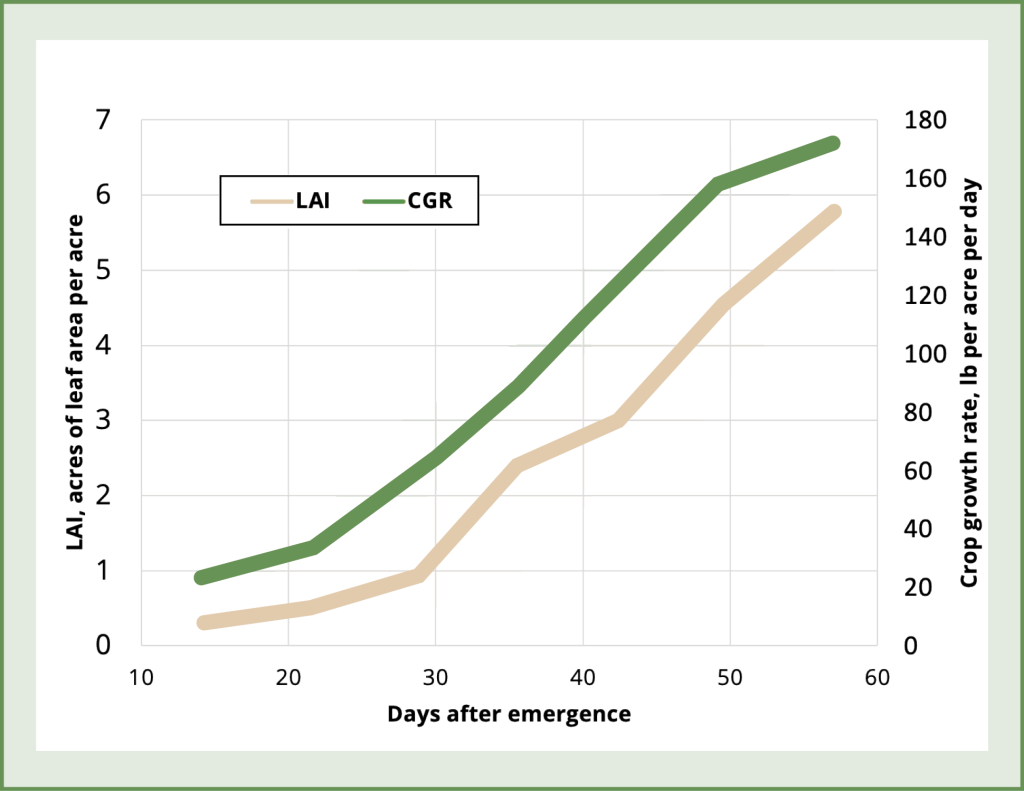
The amount and distribution of leaf area together make up the canopy, and canopy cover increases as leaf area increases. Leaf area is measured as the leaf area index (LAI) or the acres of leaf area per acre of crop. Because leaves aren’t uniformly distributed, and because some light passes through a leaf without being intercepted, LAI may need to reach 5 or 6 before the crop intercepts nearly all of the sunlight. Light interception, canopy photosynthesis, and crop growth rates increase as the canopy develops, with light interception increasing from less than 1% of the amount of sunlight that falls on an acre as plants emerge, to nearly 100% during pod filling. An early start and rapid pace of canopy development means more rapid increases in crop growth rate (Figure 1), which sets the stage for higher yields.
Vegetative Stages VC to V3
Small plants with little leaf area do not intercept very much sunlight, so when plants stay small during the lengthening days of May and June, they grow slowly. Early growth is typically slowed by cool temperatures, and there is no management solution to this problem.
Early planting helps, as long as temperatures allow for timely emergence and vigorous growth after emergence.
Early in the season, plants growing under cool or wet conditions often have poor leaf color, usually related to limited root development and low availability of nutrients from the soil.
Plants growing in narrow rows (<30 inches) develop leaf area at about the same rate as plants in wide rows, but the leaf area is better distributed, so light interception is higher during early vegetative growth in narrow rows. This sometimes provides an advantage in the shorter vegetative development periods in northern environments or in late-planted soybeans (including double-crop).

| MISCONCEPTION | REALITY |
|---|---|
| Very early planting often means that cool temperatures limit early growth, but plants can still grow their root system even if leaves don’t grow very much. | Once the reserves in the cotyledons are used up, growth requires light interception by leaves and air temperatures above 55-60 F; without this, no part of the plant will show much growth. |
| Leaf area needs to develop rapidly from the beginning, and all of the leaf area the plant develops needs to stay healthy for yields to be high. | Vegetative development takes place over more than half of the soybean growing season, so leaf area lost early can often be recovered as growth continues with no loss in yield. |
| Leaves should be dark green, and any pale green or other off-colors that appear in young plants signal yield losses to come. Tissue sampling can detect specific nutrient deficiencies, and these should be corrected as soon as possible. | Low temperatures and cold soils alone can cause poor leaf color. Small plants have small root systems and acquire nutrients slowly, with few exceptions (i.e., iron chlorosis, caused by high pH). Poor plant color usually corrects quickly once temperatures increase with no loss in yield. |
Vegetative Stages V4 to Vx (until R1)
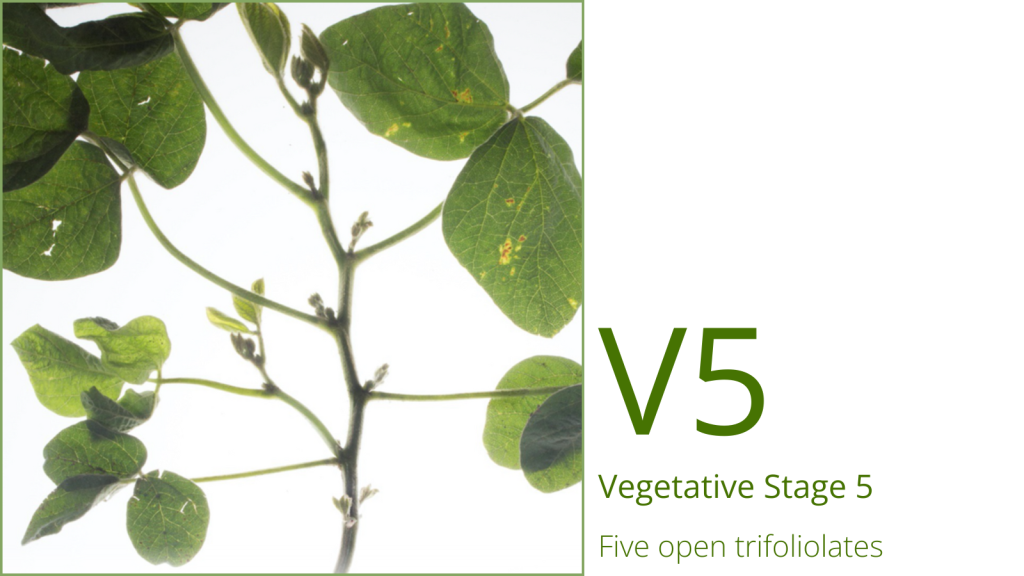
Plant size and leaf area begin to increase rapidly by the time the plant has 4 or 5 trifoliolate leaves (stage V4 or V5), with an LAI of about 1.
New leaves grow above older ones, so a crop with an LAI of 1 intercepts only some of the sunlight; the rest hits the soil, especially in wide rows. Leaf area develops rapidly during this period: The crop can add an acre of leaf area per week, or some 5,000 square feet of leaf area per acre per day. About half the dry matter produced by the plant goes into leaves during this period.
Nodule formation can begin as early as V1 with N fixation typically initiating by about stage V2. Soils often supply additional N from mineralization of soil organic N to help plants during early growth; if low soil organic matter or cold or dry conditions limit soil N, N fertilizer rarely but occasionally helps the plants get off to a faster start. However, research has indicated that additional N applications do not increase yield where adequate N fixation occurs.
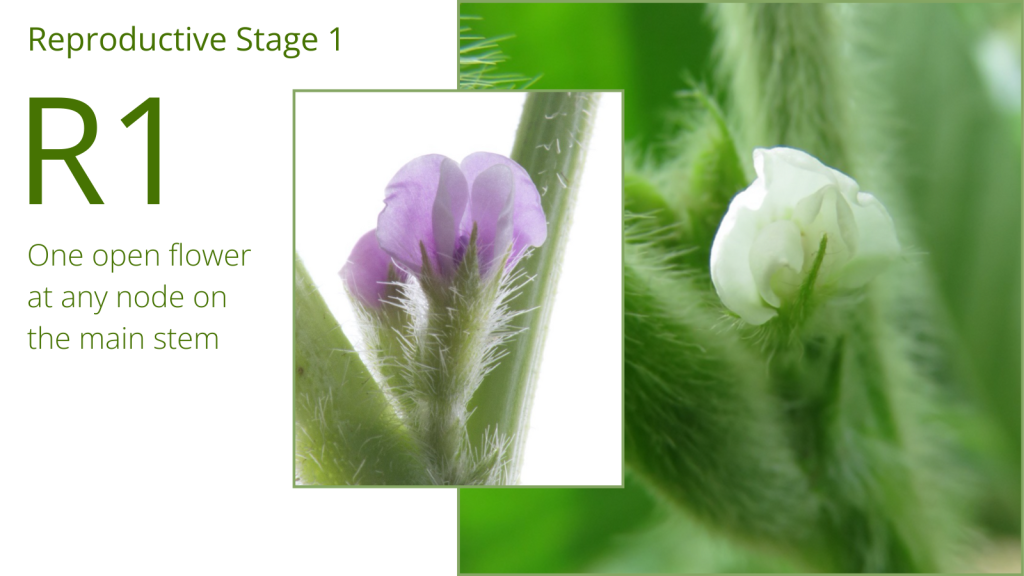
Vegetative growth – increases in leaf area and plant dry weight – continues in indeterminate varieties from VC through flowering (R1, usually at V8-V9) to the beginning of rapid seed filling (R5.5). Late-maturing varieties (MG 5 or later) grown in parts of the southern U.S. flower later, but complete most of their vegetative development by stage R1.
The addition of each leaf during this phase means the addition of another node on the stem; each node has a leaf attached, and a raceme – a short branch where flowers and pods form. Plant height increases as nodes are added, but the length of each internode is determined by temperature and moisture, and node number per plant is more important than plant height. Medium-height plants with adequate numbers of nodes and pods are preferable to tall plants, even if tall plants have more leaf area.
Plants at lower populations form more branches, each with leaves and the capacity to form pods and add yield. Branch formation acts as a “pressure valve” that gives plants with more space additional leaf area and the capacity to support more growth. This capacity helps to neutralize loss of plants or leaves during vegetative growth.
Although the ideal is for leaf area and plant dry weight to continue to increase during this period without interruption, research has shown that loss in leaf area during this period typically has little or no effect on yield potential if conditions are favorable to allow regrowth after the damage occurs. Leaf area loss due to hail or herbicide injury, or leaf area restrictions from lack of adequate water or herbicide, can all be made up if followed by a period of rapid growth.
| MISCONCEPTION | REALITY |
|---|---|
| Some stress during vegetative development tends to set the soybean crop up for higher yields, so can be useful. | While it is possible for soybean plants to overcome the effects of stress during vegetative growth and avoid yield loss, there is no solid evidence that such stress actually leads to increased yields. |
| Tall, leafy soybean plants have the best potential to produce high yields. | Tall, leafy plants can suffer from shading of the interior of the canopy and from depleting soil water more quickly, which can result in yield loss. In addition, tall plants have a greater likelihood of lodging later in the growing season. |
| Compared to normal-sized plants, short, compact plants often produce more pods and higher yields. | Short plants can produce high yields, but if dry soils or low plant populations limit plant height, pod numbers, and canopy cover, yields will usually be lower. |
Reproductive Growth Stages
Shift from Vegetative to Reproductive Stages
During this period, the soybean plants begin to shift from vegetative to reproductive growth, although most of the dry weight that accumulates gets allocated to vegetative tissue. The main task of the plant is to prepare to direct all of its resources towards maximizing seed dry weight over the 30 days or so between the start and end of seed fill. Yield accumulation rates as high as four bushels per acre per day have been measured under Corn Belt conditions. This requires maximum light interception by a healthy canopy.
Plants reach their maximum height, node numbers, pod numbers and weight of vegetative parts (leaves, stems and petioles) by the beginning of seed fill, just past stage R5. Under rare circumstances, such as drought before R5 followed by rainfall, plants can add a few additional nodes and pods at the tip of the plant, but these usually have limited leaf area and often add little yield.
The maximum LAI is typically 4 to 6, but as lower leaves are shaded, they lose their green color and translocate their N to the rest of the plant. By early seed filling, the effective canopy consists mostly of the leaves on the upper two-thirds of the nodes. Large leaves on the upper part of the pant provide the most photosynthate to pods at these nodes. The LAI counting only these most effective leaves is about 4 to 5.
Unless dry soils restrict root access to immobile nutrients (P, K, Fe, Mn) in the soil or decrease N fixation, nutrient deficiency symptoms are uncommon in soybean during these stages. Leaf color should darken as leaves mature and thicken. Leaves act as the major N storage organ for soybeans, with as much as 40% to 50% of the N that ends up in the seed already accumulated by stage R5.5, before seed filling gets underway. In nearly every field, this N can be supplied by soil N plus N fixed in nodules; applying in-season N to a soybean crop with good canopy color is highly unlikely to add yield.
The period leading up to the seed fill period is a critical one for vegetative tissue; yield loss due to the loss of 50% of the leaf area increases from 3% at R1 to 19% at R5; for a loss of 75% of the leaf area, yield loss ranges from 10% at R1 to 43% at R5. Losses from late defoliation are greater because plants can no longer produce new leaf area to compensate for the loss. Yield losses are not proportional to leaf area loss because the loss of leaf area means that light reaches lower leaves, and because green pods, stems, and petioles can photosynthesize to help make up for lost leaf area.
| MISCONCEPTION | REALITY |
|---|---|
| If the crop canopy isn’t complete by the beginning of flowering, yields won’t reach maximum potential. | The soybean plant can flower as early as stage V3 or V4, but continues to add leaf area up to stage R5, which comes as much as 4 to 6 weeks later. As long as the canopy is complete by the beginning of seed filling, the plant has the potential to reach full yield. |
| Tall, green, leafy soybean plants have the best potential to produce high yields. | Plant structure is based on several factors, including plant population density. Plants with differing numbers of branches or leaves don’t necessarily results in a difference in yield on a per area basis. Water use reaches a maximum during this period, so water stress is more likely to appear and to limit leaf expansion, and subsequently yield. |
| Throughout the growing season, all soybean plants in a field should be uniform in size, weight and pod number; if they aren’t, yield will be lower. | Soybean plants grown at normal plant populations always develop a great deal of variability in size and pod numbers, even if they are uniform early in the season. Reasons for this are not well-understood, but larger plants adjust to compensate for smaller ones, and there is no indication that this causes lower yields. Smaller soybean plants do not act “weedy”, lowering yields of larger plants in a full stand. |
Reproductive Stage Flowering (R1-R2)
While adequate soybean flowers are needed for reproductive development, soybeans are amazingly resilient to stress during flowering due to their ability to continue to develop flowers over several weeks, regardless of their growth habit. Indeterminate soybeans will flower for two to three weeks longer than determinate varieties and can continue to flower while pods and seeds are developing.
Flowering marks the beginning of rapid dry weight and nutrient accumulation rates. Therefore, duration of light interception and thermal energy/heat unit accumulation provide the potential for flower and pod retention and seed fill.
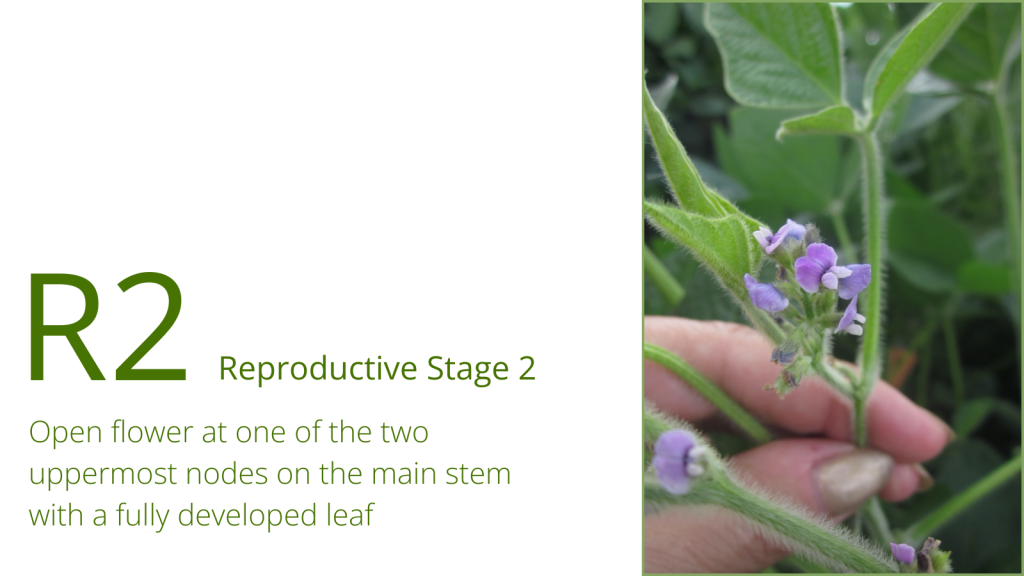
| RISKS DURING FLOWERING | OPTIONS TO MANAGE THE RISKS |
|---|---|
| Disease Development | Scout and manage foliar diseases at this stage, with attention to White Mold in Northern U.S. environments. |
| Herbicide Damage/Weed Escapes | R1/R2 growth stages are the cutoff for application timing of many herbicides. Applying herbicides after the last stage listed on the label can result in physiological injury that lowers pod or seed numbers and yield. |
| High Temperatures | Temperatures over 90-95 F can cause flower abortion. If possible, use irrigation to lower canopy temperature when air temperatures are this high. |
| MISCONCEPTION | REALITY |
|---|---|
| Flower abortion reduces yield. | Soybeans naturally abort 20%-80% of its flowers. Soybean plants produce many more flowers over a long period of time than can be supported by the plant as a mechanism to avoid the impact of short periods of stress. |
| Soybean will not flower until the summer solstice | Early planted soybeans experience shorter days before June 21, so floral induction and the subsequent appearance of flowers may occur ahead of the summer solstice. |
| Flower damage should trigger subsequent management. | Insects such as corn earworm can feed on and damage flowers. However, due to the compensatory mechanisms of the plant during flowering, it is rarely economical to treat for something that is damaging flowers alone. |
| Sugar can be applied to produce more flowers. | It has been proposed in the past that foliar applications of sugar can make the plant set more flowers; however, this is not the case. |
Reproductive Stage Pod Set (R3-R4)
The number of pods per acre sets the maximum number of seeds per acre, which is the component most strongly related to final yield. Therefore, pod development becomes one of the most critical stages in the life of soybean. While stress at this time will result in aborted pods, seed number per pod and seed size may compensate for loss of pods.
| RISKS TO POD FORMATION & RETENTION | OPTIONS TO MANAGE THE RISKS |
|---|---|
| Drought and/or High Temperature | Plant a range of maturity groups and/or alter planting dates (southern regions) to hedge against stress. If available, irrigation should begin/continue at the R3 to R4 growth stage to retain yield potential. |
| Disease | Understand which diseases are common for your region as well as the environmental conditions that promote these diseases. Check the specific disease resistance of your soybean variety and scout your field regularly. Spray a foliar fungicide if needed based on your state guidelines. Prophylactic application of fungicides at this stage rarely increases soybean yield and can lead to resistance to the fungicide. |
| Insects | Scout fields. Do not spray a foliar insecticide unless economic thresholds are reached based on your state’s guidelines. Broad-spectrum insecticides will kill beneficial insects and increase late-season insect pests. Over use of insecticide can lead to insecticide resistance. |
| Weed Competition | A closed plant canopy should reduce competition from late-emerging and resistant weeds. Physically remove escapes before weed seed formation. |
| Foliar Fertilizer | Scout fields. Confirm nutrient deficiencies with tissue and soil samples from deficient and normal areas of the field. Research has shown that prophylactic use of foliar fertilizer products does not increaseyield or change grain composition. This means that there is no scientific evidence for their use withoutvisual symptoms of a nutrient deficiency present. |
| MISCONCEPTION | REALITY |
|---|---|
| The soybean plant needs to retain most of its pods to maximize yield. | Pod abortion occurs naturally and allows the soybean plant to adapt to current environmental conditions. Many pods will still abort under stress-free conditions. |
| Presence of 4 and 5 bean pods is required for high yields. | Pod number and seed size affect yield more than seeds per pod. |
| Light needs to penetrate the whole canopy. | Complete canopy closure by this stage is important to capture all available sunlight, retain soil moisture, and reduce weed competition. |
| Making a sprayer trip across the field will either be beneficial or neutral. | Tire traffic at this stage can lead to yield declines. |
| Foliar fertilizers will be beneficial to provide nutrients to the pods and will impact yield. | Data from across the U.S. shows no yield benefit to foliar fertilizer application at R3 in the absence of a visual nutrient deficiency. |
| Late season nitrogen applications will provide a positive return on investment. | Data from across the U.S. shows no consistent economic benefit to late-season nitrogen fertilizer application. |

Reproductive Stage Pod Set through Maturity (R5-R8)
- Protect and maintain leaf area from vegetative growth (engine capacity for seed fill) through senescence.
- Minimize stressors such as loss of leaf area, nutrient deficiencies, and excessive/deficient water.
- Careful harvest before grain moisture drops below 13%.
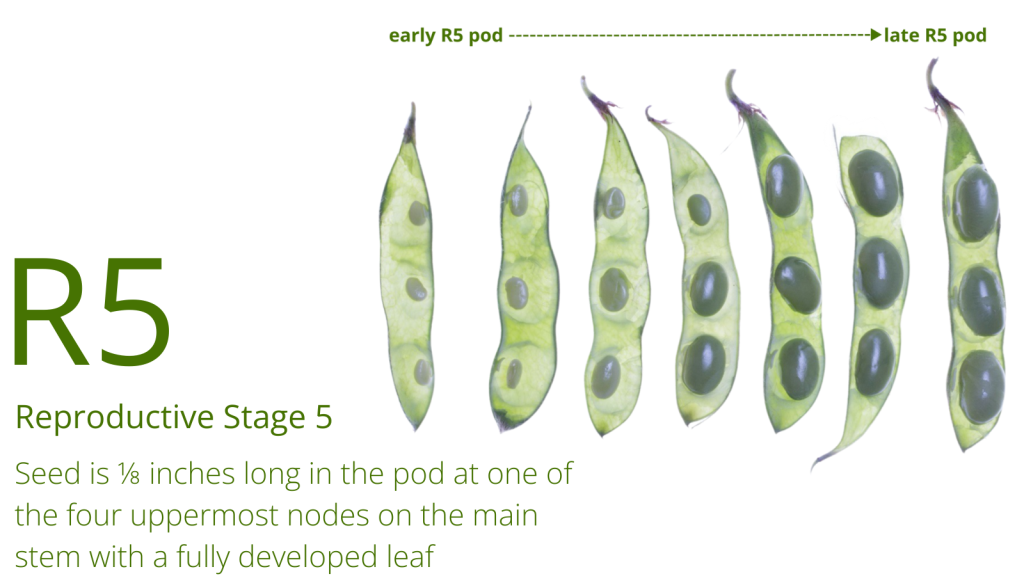
| RISKS TO SEED SET THROUGH MATURITY | OPTIONS TO MANAGE THE RISKS |
|---|---|
| Loss of Leaf Tissue (by disease, insects, hail, etc.): Once soybean transitions to seed set, the plant can no longer compensate for lost leaves or reduced photosynthetic rate. Soybean is most sensitive to stresses during early seed set (around R5.5). External stressors have less effect on yield after early seed filling (R6). | Scout for insects that feed on pods or seeds such as stink bugs. Apply insecticides if insects are at threshold, ensure that pre-harvest intervals are maintained. Scout for diseases that could reduce photosynthetic capacity or seed fill to determine disease severity. However, fungicide treatments are not recommended at this time for most diseases. |
| Water Availability: Drought and flooding events during seed fill can limit nutrient availability from the soil. Severe drought or flooding will inhibit both photosynthesis and the mobilization of nutrients to the seed. | In many soils and regions, soybeans planted no-till may have better access to soil water and show less drought stress when rainfall is less than normal. Practices such as manure fertilization or cover cropping can help build organic matter and support soil moisture retention. |
| Nutrient Deficiency: About half of the seed’s requirement for N, P, and K comes from nutrients taken up by the plant during vegetative growth and redistributed (mostly from the leaves) during seed filling, while the remainder must come from soil uptake during seed fill. | Soil fertility issues should be addressed before planting. Little can be done during seed filling. Foliar fertilizers will not typically improve yields; foliar products are unable to provide high enough levels to compensate for deficiencies. |
| Green Stem Syndrome | When pod or seed number is unexpectedly reduced, sugars accumulate in the stems. The seeds and pods will mature normally, but the stems remain green. Depending on location and severity, producers may need to wait for a killing frost to harvest these areas. The recommendation is to harvest as soon asmechanically possible. |
| Timely Harvest | Soybean harvest should begin once seed moisture drops below 14-15%, and should proceed as quickly as the weather allows. Seed shatter from pods and seed breakage increase rapidly as seed moisture at harvest drops to 10% or less. |
| MISCONCEPTION | REALITY |
|---|---|
| Applying a product to “reduce drought stress” during seed set will result in greater yields. | Drought stress during seed set will result in seed abortion and/or reduced seed fill. No products will overcome the lack of water. |
| Applying a product to “alleviate flooding” will result in greater yields. | Flooding will saturate soils and kill root hairs and limit nutrient uptake. Foliar products cannot be applied at a high enough rate to overcome these deficiencies. |
| Five pounds of sugar per acre will improve seed set or seed size. | Soybeans produce and use about 6,400 pounds of sugar to set and develop 80 bushels of seed. Applying five pounds of sugar per acre is like emptying a 20 oz. bottle of water into the ocean to reduce salinity. |
Learn More
Learn more from A Visual Guide To Soybean Growth Stages. Thank you to Shawn P. Conley, University of Wisconsin-Madison, for the use of images from that publication.
References
Board, J. (2000), Light Interception Efficiency and Light Quality Affect Yield Compensation of Soybean at Low Plant Populations. Crop Sci., 40: 1285-1294. https:// doi.org/10.2135/cropsci2000.4051285x
Authors: Jenny Carleo, North Carolina State University: Shaun Casteel, Purdue University; Shawn Conley, University of Wisconsin; David Holshouser, Virginia Tech University; Chad Lee, University of Kentucky; Mark Licht, Iowa State University; Laura Lindsey, Ohio State University; Hans Kandel, North Dakota State University; Jonathan Kleinjan, South Dakota State University; Carrie Knott, University of Kentucky; Seth Naeve, University of Minnesota; Emerson Nafziger, University of Illinois; Haleigh Ortmeier-Clarke, North Carolina State University; Michael Plumblee, Clemson University; Jeremy Ross, University of Arkansas; Maninder Singh, Michigan State University; Rachel Vann, North Carolina State University.