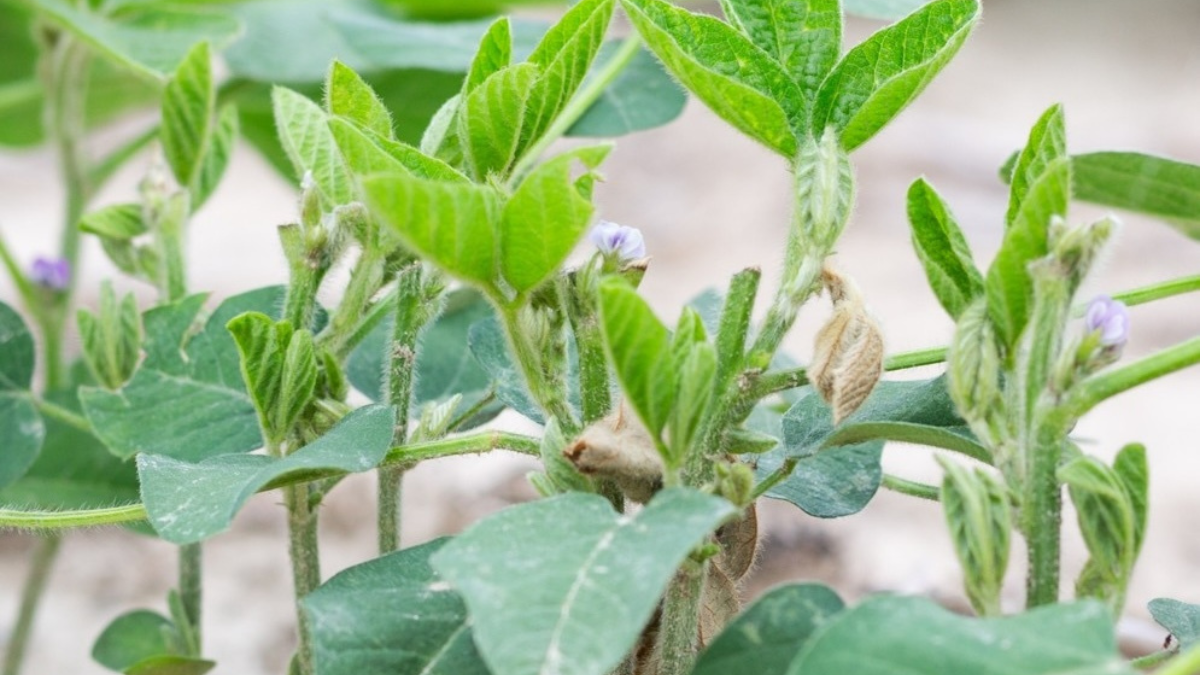
Potassium deficiency is a common yield limiting factor in soybean production. Hidden hunger poses diagnostic challenges, as yield loss can occur without any visual symptoms to indicate there is a problem. Although diagnosing K deficiencies requires proactive management, it can be corrected in-season with proper management to minimize yield loss.
Hidden Hunger
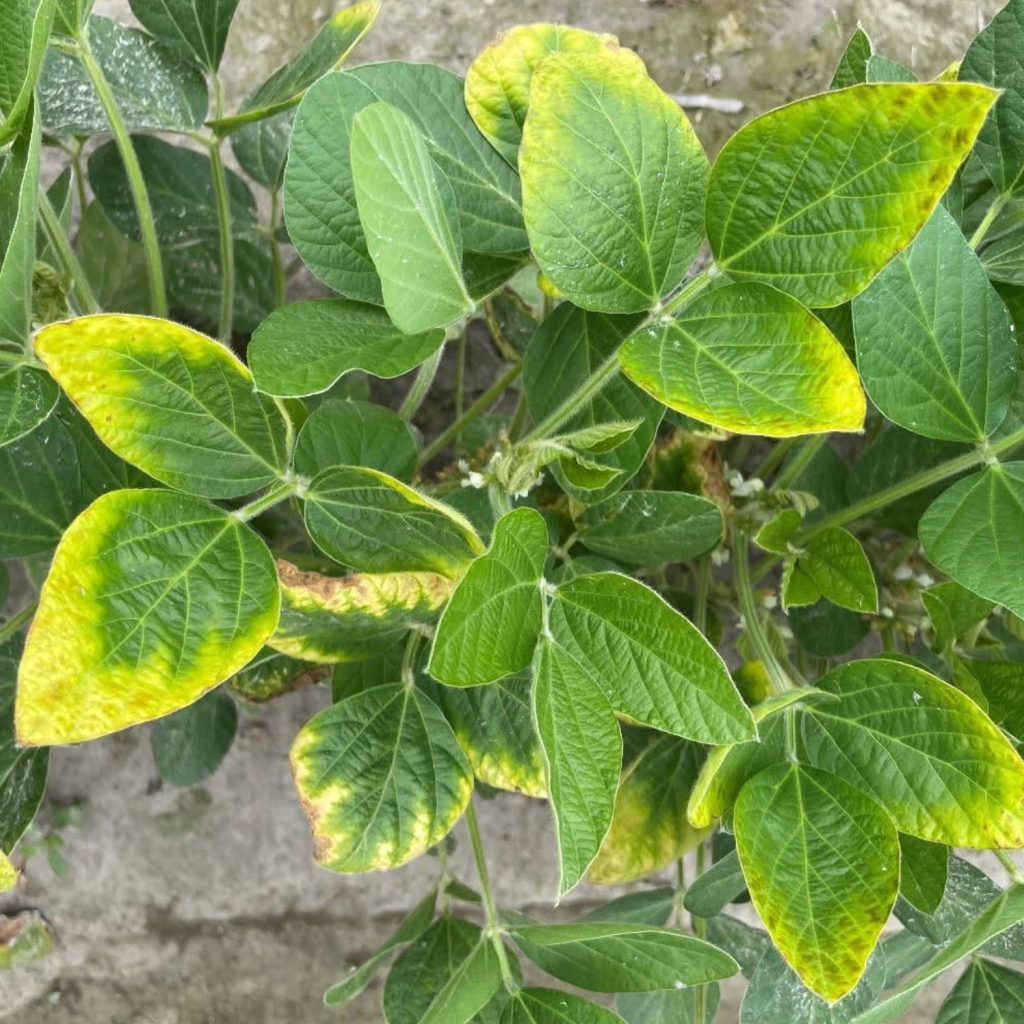
Potassium (K) deficiency appears as the yellowing edges of leaves and can be found in the lower portion of the canopy in determinate soybeans or the mid and upper portion of the canopy in indeterminate soybeans. By the time we see visual symptoms, however, the K deficiency is severe. K deficiencies will not usually show any visual symptoms while still limiting yield. This “hidden hunger” is a major challenge to K deficiency diagnosis.
Action Step
Routine soil sampling and following your state’s recommendations for both fertilizer and lime applications is important for all nutrient management. In lighter textured soils or fields with a history of crop biomass removal (ie. hay production) or a history of K deficiency, tissue testing to confirm sufficiency is recommended.
Tissue Testing
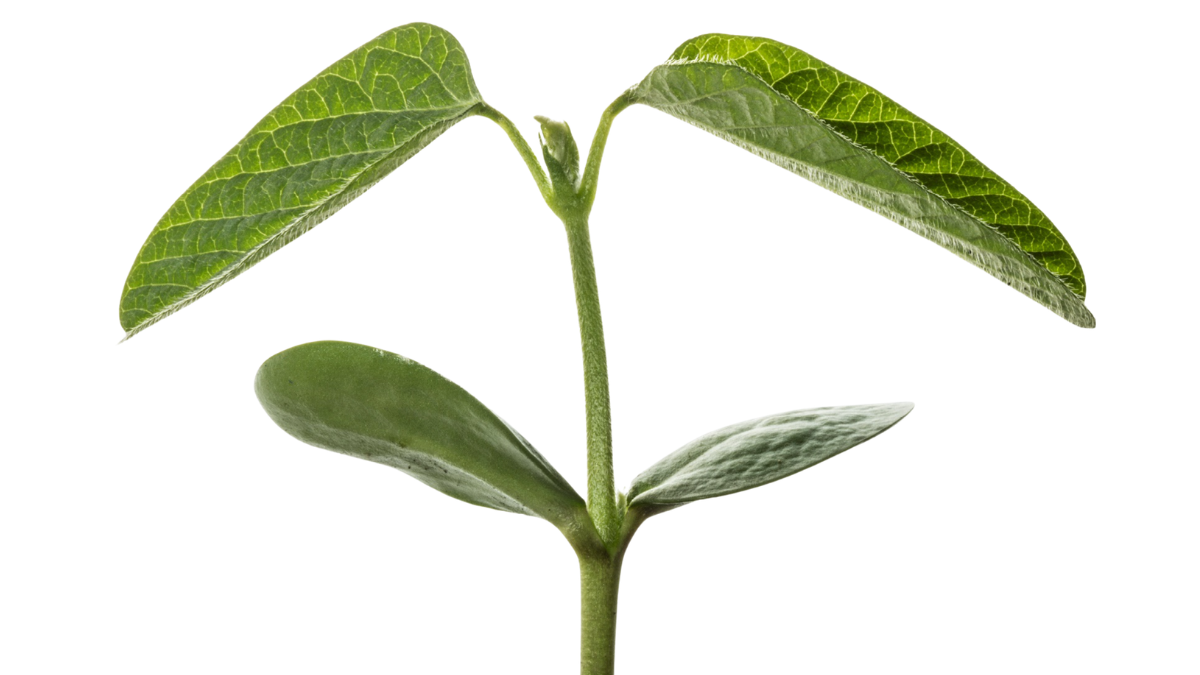
Diagnosis of mild to moderate K deficiency requires proactive tissue testing to monitor the crop’s nutrient status, beginning at first flower (R1). Fields should be divided into management zones based on any soil textural changes or known management differences. Within each management zone, one composite sample of at least 18 uppermost fully expanded trifoliate leaflets should be collected for analysis.¹ The uppermost fully expanded leaf is usually 2-3 nodes from the top of the plant and may be identified by a darker color and coarser texture. Using any local laboratory, a nutrient analysis will provide the leaf-K concentration.
The time of first flower (R1) can be observed in the field or estimated with an online prediction tool. One possible tool is SoyStage, which uses local weather data to provide an estimate of key growth stages.²
Interpretation & Diagnostics
Proper sampling methods and interpretation are critical for accurately managing in-season K in soybeans.
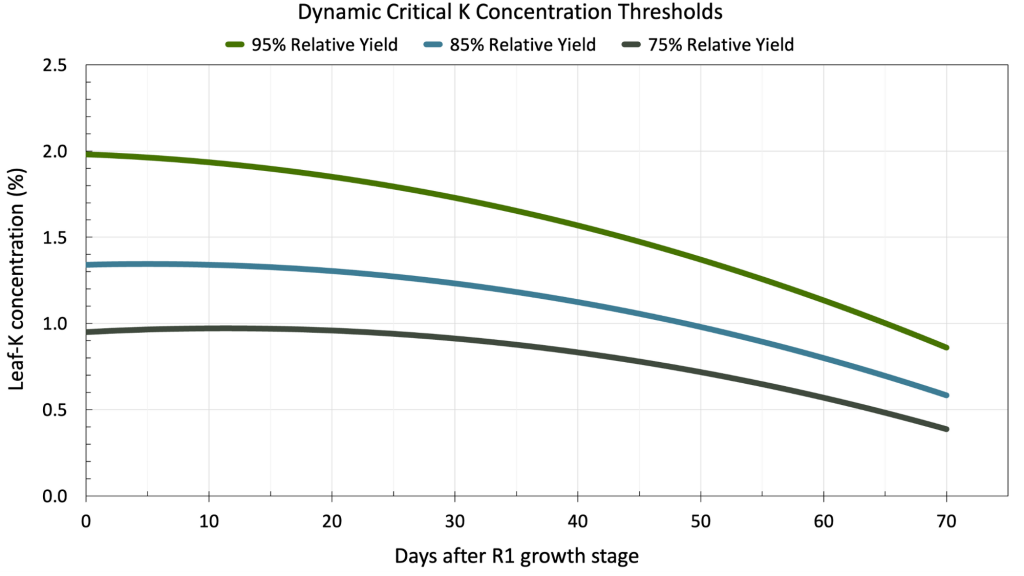
Traditional thresholds only consider the full flower (R2) growth stage, and are not accurate outside of that timing. The threshold for sufficiency, measured as leaf-K concentration, changes throughout the reproductive growth stages due to the mobility of K in the crop.
The dynamic critical concentration curve (below) provides the threshold at any point during flowering, pod set, and seed fill stages. The % Relative Yield assumes no corrective in-season fertilizer-K is applied.
The 4 Rs of Nutrient Management
Applying in-season fertilizer-K can help minimize yield loss, but depends on severity of deficiency.

Key Takeaways
- Proper nutrient management always begins with routine soil sampling.
- Do not rely on visual symptoms to diagnose a K deficiency in soybeans, hidden hunger is common.
- A K deficiency can be corrected within 20-44 days after first flower, depending on the severity
- In-season yield loss from K deficiencies can be minimized with proper management.
Author: Carrie Ortel, Virginia Tech, June 2025
References
1. Ortel, C.C., Roberts, T.L., Hoegenauer, K.A., Poncet, A.M., Slaton, N.A., & Ross, W.J. (2023). Mapping variability of soybean leaf potassium concentrations to develop a sampling protocol. Agrosystems, Geosciences and Environment, 6(4). https://doi.org/10.1002/agg2.20439
2. dos Santos, C., M. Salmerόn, & L.C. Purcell. (2019). Soybean phenology prediction tool for the Midsouth. Agric. Environ. Let., 4(1):190036. https://doi.org/10.2134/ael2019.09.0036
3. G.L., Parvej, R., & Roberts, T.L. (2021). Dynamic critical potassium concentrations in soybean leaves and petioles for monitoring potassium nutrition. Agronomy Journal, 113(6), 5472–5482. https://doi.org/10.1002/agj2.20819
4. Slaton, N.A., Roberts, T.L., Ross, W.J., & Richmond, T.L. (2020). Irrigated soybean response to granular fertilizer potassium application timing. Agronomy Journal, 1–14. https://doi.org/10.1002/agj2.20342