Extreme weather events, such as heavy rains, drought, or storms, often disrupt crop production in the U.S., leading to failed plant stands. Before replanting a field, it is important to consider what preemergence (PRE) herbicides have already been used. Residual herbicides can pose significant challenges when growers decide to replant a failed corn stand with soybeans.
The Challenge of Residual Herbicides
Residual herbicides are defined by the length of time that they are available in the soil profile, and more specifically the rooting zone. Several factors contribute to their persistence or time they remain in the soil, including temperature, rainfall, soil type, and organic matter.
For example, sandy soils with low organic matter can have reduced herbicide binding, or adherence to soil particles, which then remains in the soil solution (water). As a result, sensitive crops have an increased risk of herbicide carryover injury. Many of the PRE herbicides used in corn are chosen for their ability to control weeds long term, which is great for weed control, but can complicate replanting decisions when corn fails early in the season.
“Bleaching” herbicides are commonly used in corn herbicide programs, but often carry restrictions on replanting soybeans ranging from 8 to 10 months. With growers looking for alternatives when faced with early season challenges, researchers have re-evaluated soybean response to bleaching herbicides in sandy soils.
The Soybean Response
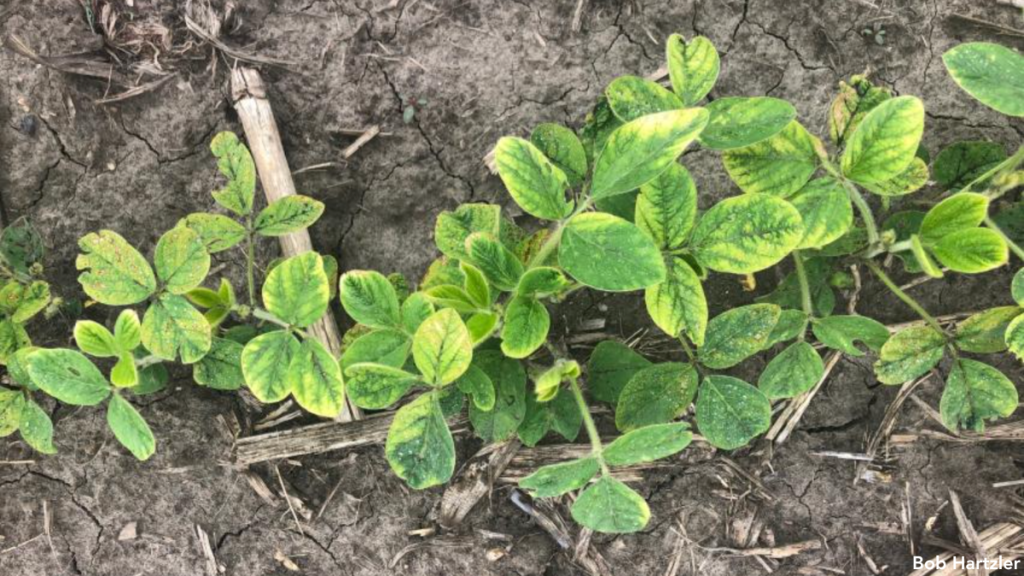
Findings have indicated that mesotrione and tembotrione are relatively safe for soybeans replanted after a failed corn stand. Across all replanting dates (30, 60, and 90 days after application [DAA]) and years (2023-2024), these herbicides caused only minor, transient symptoms like bleaching or chlorosis, with no significant yield reductions compared to a non-treated control. This makes them suitable choices for corn weed management when replanting soybeans is a possibility.
Conversely, tolpyralate and topramezone showed substantial carryover risks. When soybeans were replanted at 30 DAA, yield losses were severe at 94% and 100% in 2023 and 24% and 39% in 2024 for tolpyralate and topramezone, respectively. At 60 DAA, yields were reduced by 38% and 62% for these herbicides, respectively. In 2023, even at 90 DAA, tolpyralate caused a yield loss of 31% and topramezone caused yield loss of 68%, though no yield reductions were observed in 2024 at this interval. These results indicate that tolpyralate and topramezone are high-risk options for replanting soybeans in sandy soils.
Management to Reduce Risk
To minimize herbicide carryover injury when replanting soybeans into a failed corn stand, growers should consider the following recommendations:
- Select Safer Herbicides: Use mesotrione or tembotrione for corn weed control if replanting soybeans is a potential strategy. Avoid tolpyralate and topramezone due to their prolonged carryover effects.
- Adhere to Plant-Back Intervals: The label is the law. Follow herbicide label restrictions, which typically require 8-10 months before planting soybeans.
- Time Planting Strategically: Delaying soybean planting to 90 DAA or beyond can reduce injury from tolpyralate and topramezone, as seen in 2024, but this may conflict with the optimal planting window (late April to early June).
- Monitor Soil and Crop Conditions: Sandy soils may increase carryover risk due to low organic matter. Regular soil testing and scouting for symptoms like bleaching, stunting, or height reductions are crucial.
- Integrate Weed Management Practices: Combine herbicides with cultural practices, such as tillage or cover crops, to reduce weed pressure and reliance on residual herbicides.
Replanting soybeans in a failed corn stand can be a viable strategy to salvage the growing season, but it requires careful herbicide management to avoid carryover injury. Research confirms that mesotrione and tembotrione are safer options, while tolpyralate and topramezone pose significant yield risks. By selecting appropriate herbicides, adhering to plant-back intervals, and integrating agronomic practices, growers can mitigate risks and improve outcomes.
Author:
Nicholas J. Shay, University of Georgia