Key Points:
- Deer are a major pest concern for some soybean growers.
- Deer feeding at early vegetative stages is less likely to impact yield.
- Deer feeding at reproductive stages is more likely to impact yield.
Deer damage in soybean fields is an increasing concern across Mississippi and much of the southeastern U.S. With rising deer populations and limited management tools, growers are left wondering: How much defoliation can soybeans tolerate before it impacts yield?
Simulating Deer Damage
In 2024, my team at Mississippi State University launched a multi-year study to simulate deer browsing at different growth stages and intensities to better understand plant response and yield consequences. The findings are intended to help growers make informed decisions when deer strike their fields.
This two-year study was conducted at two MSU Research and Extension Centers: Starkville and Stoneville. Thirteen treatments simulated four leaf loss levels from simulated deer damage (0%, 25%, 50%, and 75%) at three soybean growth stages (V1, V3, and R1).
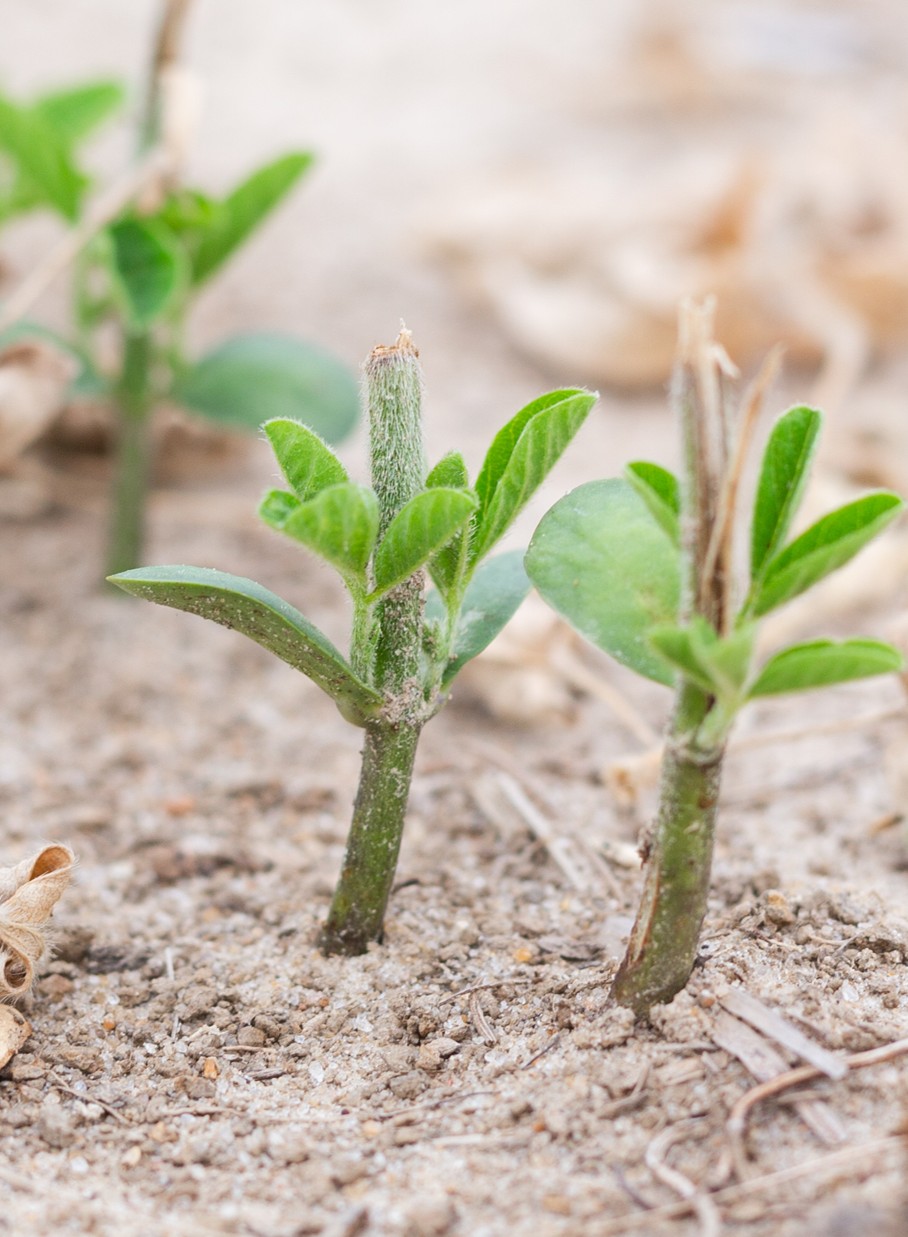
Soybean plants at the V3 growth stage that have deer damage.
The Damage Data
Key Finding 1: Soybeans Can Compensate for Early Damage
Damage at the early vegetative stages is less harmful. At the V1 stage, soybean seedlings showed impressive compensation for deer damage. Plants damaged up to 50% experienced no yield loss and were able to catch up in height and yield compared to undamaged plants.
Key Finding 2: Damage During Reproductive Stages is Costly
We found that damage at the R1 stage is more costly. By the reproductive stage, soybean plants are less resilient in their ability to recover. Even 25% damaged at R1 began to reduce yield while 75% removal resulted in statistically significant yield loss.
Key Finding 3: Damage Intensity Matters
We found that the intensity of the damage matters more than previously thought. Regardless of growth stage, 75% damage consistently led to the greatest yield reduction while 25% damage caused minimal impact.
The Bottom Line
Our results are in line with past findings from other soybean-growing regions. For example, Todd and Morgan (1972) found that soybean can tolerate moderate levels of defoliation with minimal yield loss when defoliation occurs before reproductive stages. Similarly, Rogerson et al. (2014) reported that deer pressure in Illinois could reduce soybean yields by 10–30% depending on field edge exposure and deer density.
What This Means for Farmers
Most growers can’t prevent deer from entering their fields. Understanding how soybeans respond to damage can help you gauge the severity of the issue and decide whether replanting, fencing, or other mitigation strategies are worth the investment.
Soybeans can often bounce back from even heavy browsing during early stages (V1-V3) as long as the growing point remains intact. Monitor stand uniformity and canopy closure, but don’t panic.
Take browsing damage during flowering (R1-2) more seriously. At this point, plants are investing in reproduction, not adding vegetation. Damage at this stage can lead to irreversible losses.
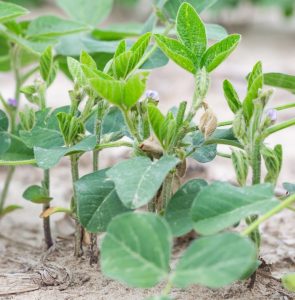
Soybean plants with deer damage.
Learn More:
If you’re considering replanting a field after deer damage, check out our factsheet. For more information on deer management, listen to this Extension podcast on “Deer, Damage and Deterrents.”
Author:
Justin Calhoun, Mississippi State University
References:
Todd, J. W., & Morgan, L. W. (1972). Effects of hand defoliation on yield and seed weight of soybeans. Journal of Economic Entomology, 65(2), 567-570. https://doi.org/10.1093/jee/65.2.567
Rogerson, J. E., Bowman, J. L., Tymkiw, E. L., Colligan, G. M., & Vasilas, B. L. (2014). The impacts of white‐tailed deer browsing and distance from the forest edge on soybean yield. Wildlife Society Bulletin, 38(3), 473-479. https://doi.org/10.1002/wsb.442