Key Takeaways:
- Collect a composite sample of at least 18 of the uppermost fully expanded soybean leaves from each management zone.
- Only collect tissue samples during favorable field conditions and adequate soil moisture.
- Consider the plant part collected (petiole included or excluded), growth stage, and nutrient mobility when interpreting results.
Tissue testing can be an effective way to monitor crop nutrition, when done correctly. To get reliable results, choose the correct, uppermost fully expanded soybean leaf during optimal conditions and carefully interpret the results. Tissue testing may begin as early as V4 but is most reliable during flowering and can continue through pod filling.
Tissue Testing Soybean
Step 1: Plan Your Sampling During Good Field Conditions
Time It Right – Field Conditions Matter
Field conditions at sampling time greatly affect the accuracy of tissue tests. Aim to collect samples when plants are actively transpiring, which usually means there is adequate soil moisture (not drought-ridden or waterlogged), temperatures are moderate, and the plant appears healthy.
It’s important to avoid sampling during drought because such conditions can limit nutrient uptake even if nutrients are present in the soil. Similarly, avoid sampling if soils are overly saturated when root function will be temporarily inhibited. Sampling should also be avoided shortly after any foliar nutrient applications. It is recommended to wait at least a week after application with a rain event to allow nutrients to be absorbed and leaf surfaces to clear.
Address In-Field Variability
Soybean nutrient levels can vary within a field due to differences in soil texture, drainage, or past management. For meaningful results, divide fields into management zones based on known variability. Take one composite sample per zone, collecting at least 18 leaves randomly throughout that area.1 This helps identify localized deficiencies and supports more precise nutrient management.
Step 2: Collect Your Leaf Sample
Choose the Right Plant Part
To get consistent and accurate results, it’s critical to sample the correct, uppermost fully expanded soybean leaf, as nutrient concentrations differ between leaves. The uppermost fully expanded soybean leaf is typically located on the second, third, or fourth node from the top of the plant (Figure 1).
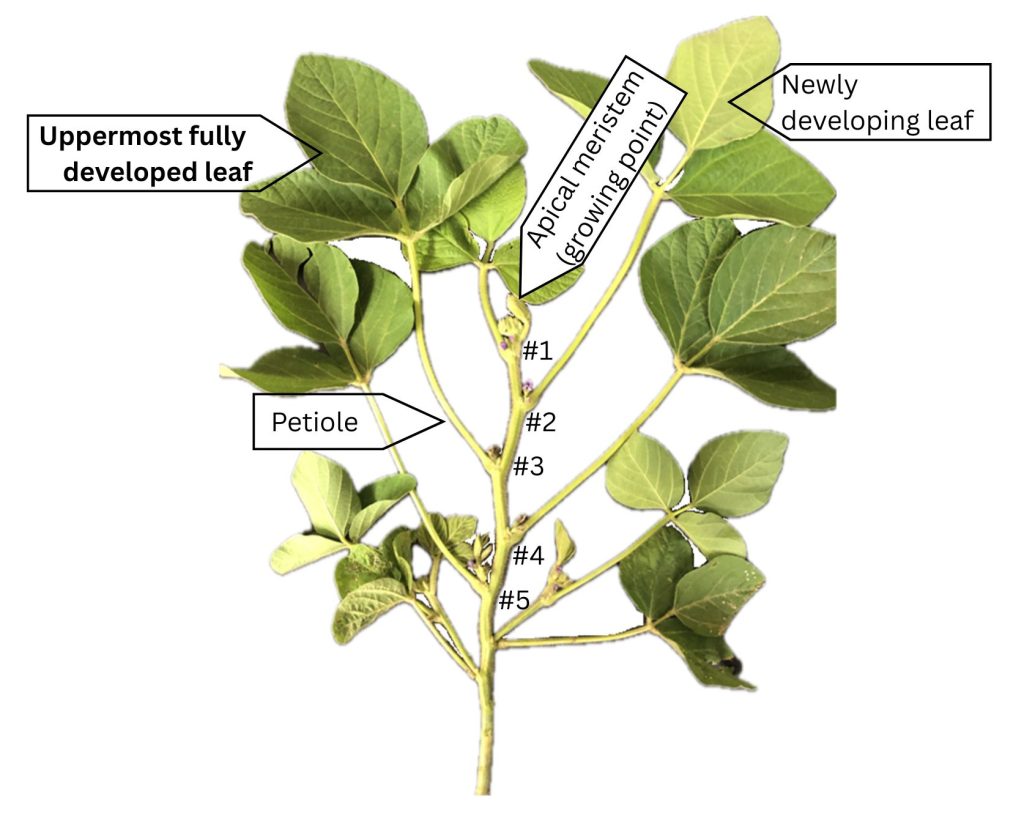
Figure 1. Soybean plant at the full flower (R2) growth stage. The uppermost fully developed leaf is shown as the leaf on the third node from the top of this plant.
Look for the highest leaf that is dark green, full-sized, and has a coarse texture. Avoid leaves with a velvety feel or ones that are lighter in color than others—these are still developing and can falsely indicate nutrient levels.
Check with your testing lab for specific guidelines. Some labs also recommend sampling the whole plant during vegetative stages or including/excluding the petiole (the stalk attaching the leaf to the stem). Be sure your sampling method agrees with the lab’s interpretation standards.
Collect the Sample Properly
Once you identify the correct leaf, follow these best practices:
- Collect 18–25 leaves per sample for a good composite.
- Take samples across a consistent management zone (based on yield history, soil type, or other field characteristics).
- Place leaves in a paper bag (not plastic) to allow drying and prevent mold.
- Note the growth stage of the soybean crop.
If your lab uses critical nutrient thresholds without the petiole (e.g., Virginia Tech), remove the petiole before bagging.
Step 3: Interpret Results with Context
Getting accurate lab results is only half the process—understanding them correctly is essential.
Use growth-stage-specific critical concentrations when available, such as potassium in soybean.2 These values indicate the threshold below which yield may be affected. If no critical values are available, use sufficiency ranges cautiously. They are less precise and based on broader surveys instead of replicated research.
Also, consider nutrient mobility. Mobile nutrients like nitrogen (N), phosphorus (P), potassium (K), and magnesium (Mg) can move within the plant and are often relocated from leaves to developing seeds and pods.3 Lower concentrations in leaves during reproductive stages may not signal a deficiency. Immobile nutrients like calcium (Ca), sulfur (S), and most micronutrients remain in their original locations and offer more stable indicators.
Although some nutrient deficiencies may not be visually apparent (hidden hunger), only take action with a corrective application of fertilizer if a deficiency occurs. Prophylactic foliar fertilizer applications have not been shown to increase yields.4 When a nutrient deficiency does occur, a corrective application of granular fertilizer should be used to correct macronutrients, while a foliar fertilizer may be used to correct micronutrients.
For more information about tissue testing soybean, please contact Carrie Ortel, Extension Soybean Agronomist, at carrieo@vt.edu.
Authors:
Carrie Ortel, Extension Soybean Agronomist, Virginia Tech
Mark Reiter, Soil Fertility Extension Specialist, Virginia Tech
Joseph Haymaker, Postdoctoral Researcher, Virginia Tech
References:
1Ortel, C. C., Roberts, T. L., Hoegenauer, K. A., Poncet, A. M., Slaton, N. A., & Ross, W. J. (2023). Mapping variability of soybean leaf potassium concentrations to develop a sampling protocol. Agrosystems, Geosciences and Environment, 6(4). https://doi.org/10.1002/agg2.20439
2Slaton, N. A., Drescher, G. L., Parvej, R., & Roberts, T. L. (2021). Dynamic critical potassium concentrations in soybean leaves and petioles for monitoring potassium nutrition. Agronomy Journal, 113(6), 5472–5482. https://doi.org/10.1002/agj2.20819
3Bender, R. R., Haegele, J. W., & Below, F. E. (2015). Nutrient uptake, partitioning, and remobilization in modern soybean varieties. Agronomy Journal, 107(2), 563–573. https://doi.org/10.2134/agronj14.0435
4Matcham, E. G., Vann, R. A., Lindsey, L. E., Gaska, J. M., Lilley, D. T., Ross, W. J., Wright, D. L., Knott, C., Lee, C. D., Moseley, D., Singh, M., Naeve, S., Irby, J. T., Wiebold, W., Kandel, H., Lofton, J., Inman, M., Kleinjan, J., Holshouser, D. L., & Conley, S. P. (2021). Foliar fertilizers rarely increase yield in United States soybean. Agronomy Journal, 113(6), 5246–5253. https://doi.org/10.1002/agj2.20889