Take Home Points
- Soybeans are more forgiving than some crops; but that doesn’t mean spacing and emergence timing don’t matter.
- Non-uniform emergence timing can cause a yield loss of ~8%, whereas non-uniform spacing can lead to a yield loss of ~0-6%.
- Spatial uniformity is especially important in low- to medium-yield environments and at lower plant densities.
What Is Uneven Emergence?
Most growers agree that uniform corn stands are critical for yield, but the same attention isn’t always given to soybeans. Recent research, however, suggests it’s time to rethink that. Uniform soybean stands, especially in terms of timing, may have a bigger impact on yield than we’ve previously believed.
Before we dive too deep, let’s clarify the two types of uniformity we often evaluate in soybean stands:
- Emergence Timing: whether all plants emerge around the same time
- Spacing: how evenly plants are distributed across the row
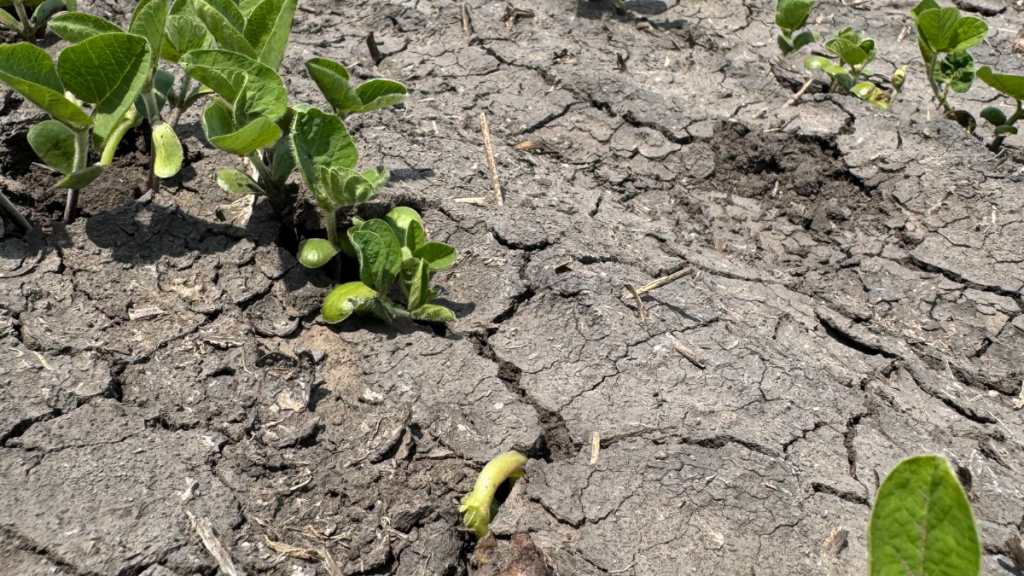
Both can impact yield, but timing matters more than spacing. Emergence differences, even by only a few days, can reduce yields by ~8%, even when plant populations are high.1 While the loss is slightly smaller, uneven spacing can still reduce yields by 0-6%.¹
Having enough plants isn’t the only important factor, so is having them emerge at the same time.
The Time Advantage
Another point to consider is the maturity group. Soybeans with earlier maturity groups were more sensitive to uneven emergence than those with later maturity groups, likely because later-maturing varieties tend to have more time and potential for branching and gap compensation.¹
It comes down to a growth advantage. Plants that emerge earlier can have a larger leaf area, faster growth, and ultimately more pods and seeds. In contrast, late-emerging plants may be unable to match the same performance.² Even those that achieve a greater size, may still produce fewer seeds. The early start gives plants a competitive edge that latecomers just can’t overcome.
Spatial uniformity is especially important in low- to medium-yield environments and in lower plant densities.3 In such scenarios, poor spacing compromises establishment and reduces the ability to compensate for gaps; especially under stress. Optimizing spacing early helps avoid those limitations later in the season.
Plasticity Limits
Soybean emergence usually happens over several days, and factors like soil crusting, residue cover, or planting method (e.g., drills vs. planters) can add to that variability. Soybeans are flexible crops, and their plasticity, the ability to adapt to challenging environments, is one of their strengths, but there are limits.
If your goal is to push yields higher, especially under less-than-ideal conditions, then uniformity in both emergence and spacing is something worth paying attention to.
References:
- Masino, A., Rugeroni, P., Borrás, L., & Rotundo, J. L. (2018). Spatial and temporal plant-to-plant variability effects on soybean yield. European Journal of Agronomy, 98, 14-24. https://doi.org/10.1016/j.eja.2018.02.006
- Ebone, L. A., Caverzan, A., Tagliari, A., Chiomento, J. L. T., Silveira, D. C., & Chavarria, G. (2020). Soybean seed vigor: Uniformity and growth as key factors to improve yield. Agronomy, 10(4), 545. https://doi.org/10.3390/agronomy10040545
- Pereyra, V. M., Bastos, L. M., de Borja Reis, A. F., Melchiori, R. J., Maltese, N. E., Appelhans, S. C., Vara Prasad, P. V., Wright, Y., Brokesh, E., Sharda, A., & Ciampitti, I. A. (2022). Early-season plant-to-plant spatial uniformity can affect soybean yields. Scientific Reports, 12(1), 17128. https://doi.org/10.1038/s41598-022-21385-z
Author: Ana Carcedo, North Dakota State University